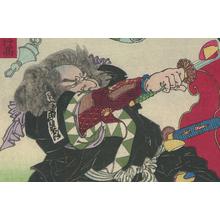
Okuda Sademon Yukitaka
- Medium:
- Woodblock print
- Source:
- Robyn Buntin of Honolulu
- Image courtesy of
- Robyn Buntin of Honolulu
Description
A warrior print (musha-e) depicting Okuda Sademon Yukitaka of the forty-seven rōnin. The Akō vendetta of 1703 — in which the loyal retainers of Asano Naganori stormed Kira's Edo mansion after a two-year period of secret planning — became one of the most extensively illustrated subjects in Japanese print history. Kyosai's multiple renderings of individual rōnin reflect sustained collector interest in the subject across the Meiji period as well as the Edo era. Each warrior was distinguished in print compositions by his specific weapon, armor details, and facial expression, allowing series of forty-seven sheets to be assembled. Okuda Sademon's role in the raid, as one of the outer wall group, informs compositions that show him in the act of assault rather than in the more deliberate preparatory poses associated with senior rōnin like Ōishi Yoshio. Kyosai's characteristic fluency of line animates the figure within the oban sheet.
More Prints by Kawanabe Kyosai
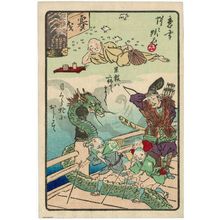
from the series One Hundred Pictures by Kyôsai (Kyôsai hyakuzu)
Woodblock print
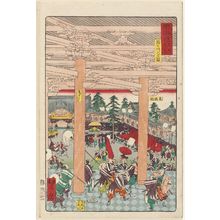
Old Picture of the Rashômon Gate (Rashômon no ko zu), from the series Scenes of Famous Places along the Tôkaidô Road (Tôkaidô meisho fûkei), also known as the Processional Tôkaidô (Gyôretsu Tôkaidô), here called Tôkaidô meisho tsuzuki
Woodblock print
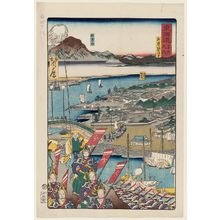
Tsukishimadera Temple in Hyôgo (Hyôgo Tsukishimadera), from the series Scenes of Famous Places along the Tôkaidô Road (Tôkaidô meisho fûkei), also known as the Processional Tôkaidô (Gyôretsu Tôkaidô), here called Tôkaidô meisho no uchi
Woodblock print
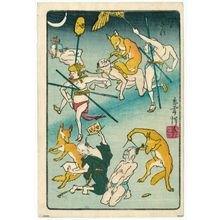
from the series One Hundred Pictures by Kyôsai (Kyôsai hyakuzu)
Woodblock print
Frequently Asked Questions
Okuda Sademon Yukitaka was created by Kawanabe Kyosai (河鍋暁斎).