
Two Ronin
- Medium:
- Mokuhanga (Japanese woodblock)
- Image courtesy of
- Saru Gallery
Description
A second treatment of the two-ronin theme, this print likely presents a variant composition — perhaps a different moment in a narrative sequence, or an alternate pairing exploring the same subject. Kyosai frequently revisited motifs across paintings, sketches, and prints, treating each iteration as an opportunity to test a different angle or expressive register. The woodblock medium imposes its own constraints on his fluid brush style: contour lines must be carved with precision, and tonal effects achieved through bokashi gradation in the printing rather than through wet-on-wet brushwork. Where his paintings of warriors lean toward improvisation, his prints show a tighter discipline, the figures locked into clearer silhouettes. The two-ronin subject sits within a broader Edo-period print tradition of warrior imagery (musha-e), but Kyosai's late-nineteenth-century engagement with the theme carries an elegiac quality. By 1868 the samurai system was being dismantled, and depictions of ronin took on the weight of a class disappearing into history rather than recurring as nostalgic adventure.
More Prints by Kawanabe Kyosai
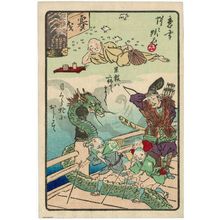
from the series One Hundred Pictures by Kyôsai (Kyôsai hyakuzu)
Woodblock print
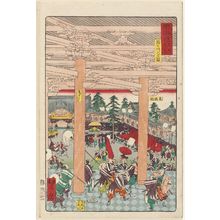
Old Picture of the Rashômon Gate (Rashômon no ko zu), from the series Scenes of Famous Places along the Tôkaidô Road (Tôkaidô meisho fûkei), also known as the Processional Tôkaidô (Gyôretsu Tôkaidô), here called Tôkaidô meisho tsuzuki
Woodblock print
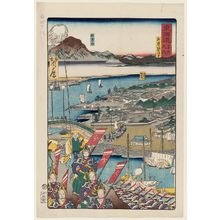
Tsukishimadera Temple in Hyôgo (Hyôgo Tsukishimadera), from the series Scenes of Famous Places along the Tôkaidô Road (Tôkaidô meisho fûkei), also known as the Processional Tôkaidô (Gyôretsu Tôkaidô), here called Tôkaidô meisho no uchi
Woodblock print
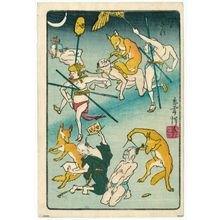
from the series One Hundred Pictures by Kyôsai (Kyôsai hyakuzu)
Woodblock print
Frequently Asked Questions
Two Ronin was created by Kawanabe Kyosai (河鍋暁斎).