
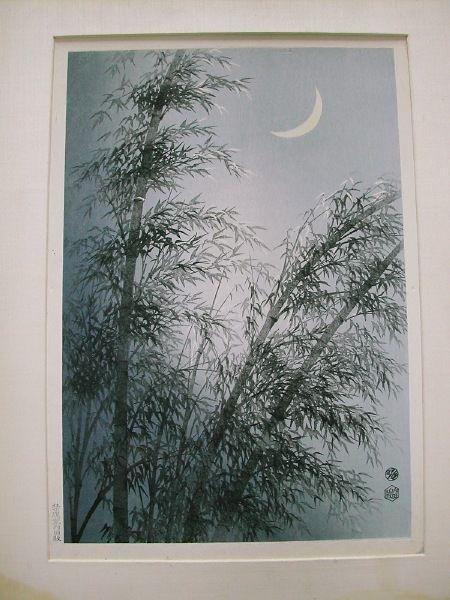
Bamboo Grove,-Kyoto
- Medium:
- Mokuhanga (Japanese woodblock)
- Image courtesy of
- Hanga Ten
Description
Kyoto's bamboo groves — most famously the Sagano grove in Arashiyama, on the western edge of the city — present a distinctive subject for woodblock printmaking. The vertical stalks of moso bamboo, ranged in dense parallel formation, create a strict pictorial structure that has attracted Japanese artists for centuries. Ohtsu's print likely renders this verticality through repeated keyblock lines printed in a darker pigment over a graded green ground, with bokashi gradations producing the diffused luminosity for which Kyoto bamboo groves are known: a soft filtered light, almost aquatic in quality, descending through the canopy to the path or earth below. The discipline of the subject — the visual rhythm of stem after stem — sits comfortably within mokuhanga's strengths, where layered transparent pigments and the absorbent surface of washi register subtle atmospheric variations. Compared with Ohtsu's village and rice-paddy scenes, the bamboo grove represents a more contemplative urban-edge subject, though one that fits his attention to seasonal and place-specific Japanese landscapes shaped by long human cultivation.
More Prints by Kazuyuki Ohtsu


More Trees Prints


Frequently Asked Questions
Bamboo Grove,-Kyoto was created by Kazuyuki Ohtsu (大津一幸).
Bamboo Grove,-Kyoto depicts trees.