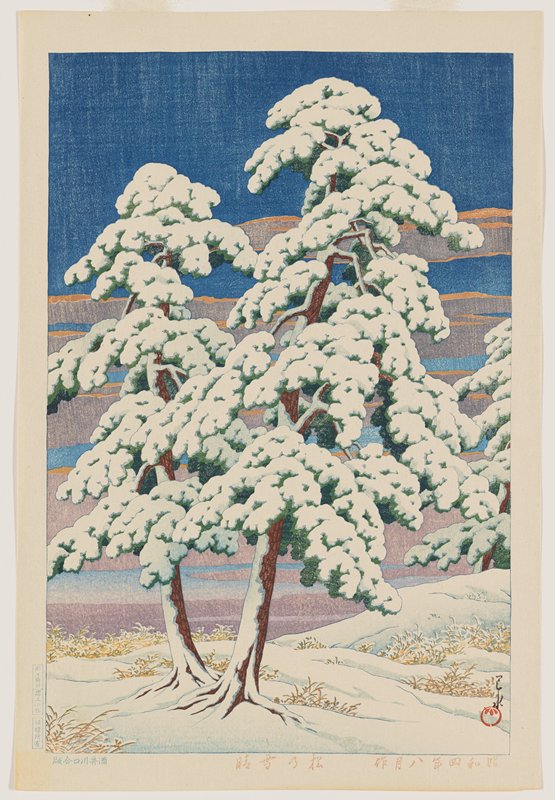
Pine Tree in Clear Weather after Snow
by Kawase Hasui
- Date:
- August 1929
- Medium:
- Woodblock print, ink and color on paper
- Format:
- Oban
- Dimensions:
- 36.2 × 24 cm
- Publisher:
- Watanabe Shozaburo
- Edition:
- Published by Watanabe Shozaburo
- Source:
- Minneapolis Institute of Art
Description
Pine Tree in Clear Weather After Snow, published in August 1929, depicts a single or paired pine tree emerging from a snowscape under the clear sky that follows a snowfall — the matsu no yukibare subject that focuses on the pine's sculptural form against a snow-brightened background rather than on the broader landscape. The pine tree (matsu) carries deep symbolism in Japanese aesthetics — longevity, constancy, resilience — and its ability to hold snow on its needles while continuing to assert its sculptural character made it a perennial subject in both poetry and visual art. The August publication date for a snow subject suggests this was a winter print released outside its season.
More Prints by Kawase Hasui
More Snow Scenes Prints
Fair Weather After Snow at Yamato Bridge, Kyoto (Yamato bashi no yukibare), Taishô period, dated 1924
Woodblock print

The Compound of the Tenman Shrine at Kameido in the Snow (Kameido Tenmangu keidai no yuki), from the series "Famous Places in the Eastern Capital (Toto meisho)"
c. 1832/38
Color woodblock print; oban

Miyajima in Snow (Yuki no Miyajima)
Yuki no Miyajima
1929
Color woodblock print; oban
Evening Snow at Shiha Park, Tokyo
1932
Woodblock print
Featured in Collections
Curated cross-cuts that include this print.
Frequently Asked Questions
Pine Tree in Clear Weather after Snow was created by Kawase Hasui (川瀬巴水) in August 1929.
Pine Tree in Clear Weather after Snow uses Bokashi, on woodblock print, ink and color on paper.
Pine Tree in Clear Weather after Snow was published by Watanabe Shozaburo (August 1929).
Pine Tree in Clear Weather after Snow depicts snow scenes and trees.
Pine Tree in Clear Weather after Snow measures 36.2 × 24 cm (Oban format).