
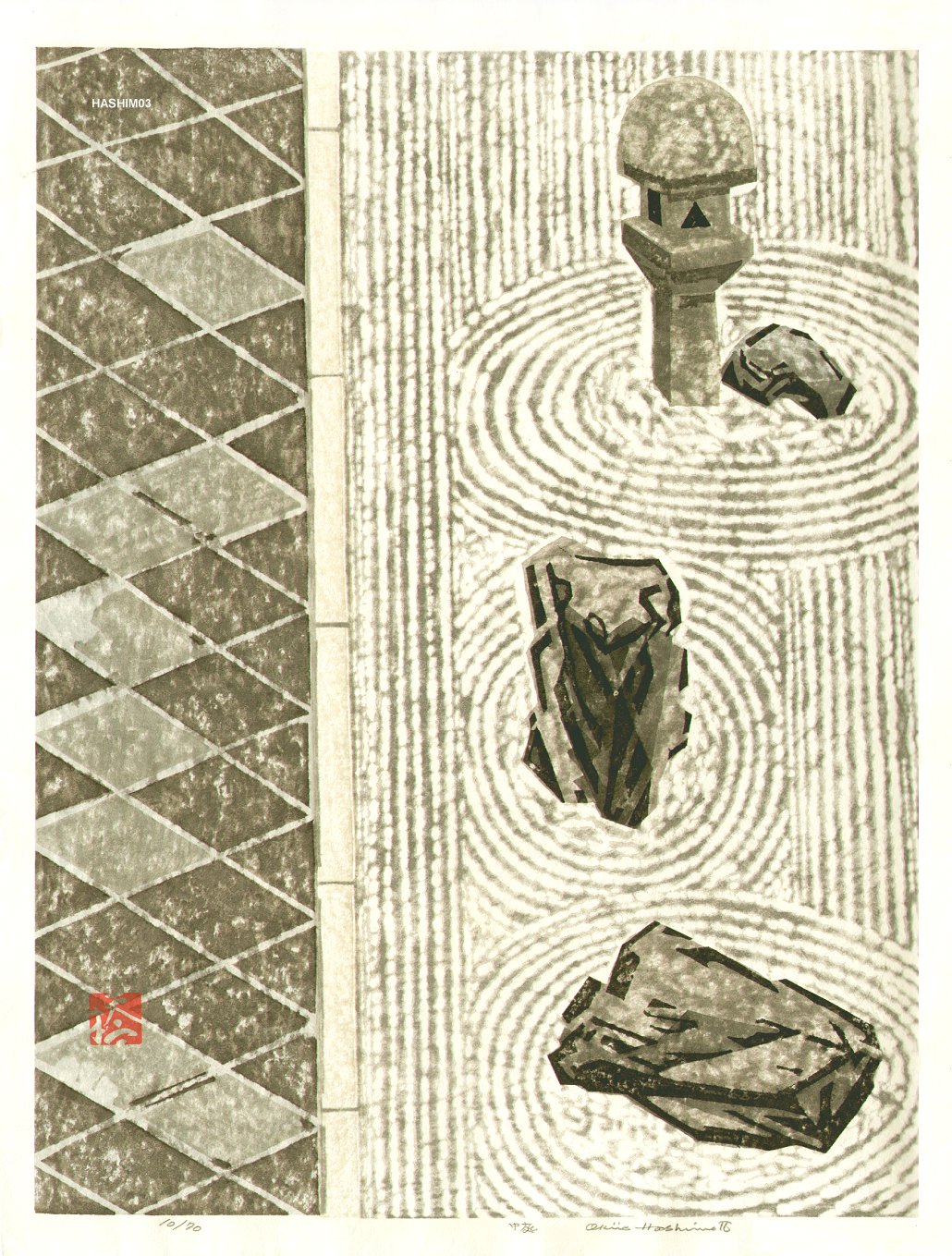
Kyoto,-Ryoanji Stone Garden
- Medium:
- Mokuhanga (Japanese woodblock)
- Image courtesy of
- Hanga Ten
Description
Ryoanji's karesansui (dry landscape) garden, with its fifteen rocks arranged in raked white gravel, has been among the most reproduced images in Japanese visual culture since its likely 15th-century construction, and a touchstone of Zen aesthetics. Ohtsu's print depicts this garden, presumably from the elevated vantage of the hojo veranda from which it is conventionally viewed. Mokuhanga is well-suited to the garden's restricted palette: the cool grey-white of raked gravel, the dark masses of moss-rimmed rocks, the warm earth tone of the surrounding clay wall capped with tile, and the green of trees beyond. The challenge is compositional rather than chromatic — communicating the calculated asymmetry of the rock placements within a flat printed frame. Such famous Kyoto subjects sit somewhat outside Ohtsu's more characteristic rural village scenes, but they fit within the broader practice of meisho-e that has run through Japanese woodblock printing since Hokusai and Hiroshige. Here, Ohtsu's quiet, evenly registered handling matches the contemplative register the garden traditionally invites.
More Prints by Kazuyuki Ohtsu


More Gardens Prints
![[Garden of] Taj Mahal, No. 1 (Taji Maharu no niwa, dai ichi) by Hiroshi Yoshida](https://www.artic.edu/iiif/2/230993a7-d4f0-c979-c267-127d48e1ef1c/full/843,/0/default.jpg)
[Garden of] Taj Mahal, No. 1 (Taji Maharu no niwa, dai ichi)
Taji Maharu no niwa, dai ichi
1931
Color woodblock print; oban

Kiyozumi Garden in Moonlight
January 1938
Woodblock print, ink and color on paper

Moon over Kiyosumi Garden (Tsuki no Kiyosumien)
1938
Color woodblock print; oban
Rock garden
10/70, 1966
Woodblock print
Frequently Asked Questions
Kyoto,-Ryoanji Stone Garden was created by Kazuyuki Ohtsu (大津一幸).
Kyoto,-Ryoanji Stone Garden depicts gardens.