
Kiyozumi Garden in Moonlight
by Kawase Hasui
- Date:
- January 1938
- Medium:
- Woodblock print, ink and color on paper
- Format:
- Oban
- Dimensions:
- 35.4 × 23.2 cm
- Publisher:
- Watanabe Shozaburo
- Edition:
- Published by Watanabe Shozaburo
- Source:
- Minneapolis Institute of Art
Description
Kiyozumi Garden in Moonlight, published in January 1938, depicts the Kiyosumi Teien — the Meiji-era landscaped garden in Fukagawa, Tokyo, built on the estate of a prominent timber merchant and later opened as a public garden — under nocturnal illumination, its central pond and carefully placed stones reflecting moonlight. Kiyosumi Garden's large central pond, ringed with prized stones brought from across Japan, and the surrounding traditional planting gave Hasui a garden subject combining intimate human-made landscape with the atmospheric effects of moonlight on still water. The January setting suggests winter moonlight over the snow-dusted or bare-branched garden.
More Prints by Kawase Hasui

More Moonlight Prints
![Mount Fuji on a Moonlit Night, Kawai Bridge (Tsukiyo no Fuji [Kawaibashi]), from the series "Selection of Views of the Tokaido (Tokaido fukei senshu)" by Kawase Hasui](https://www.artic.edu/iiif/2/d0960668-1e73-339a-b182-fb995a54bff0/full/843,/0/default.jpg)
Mount Fuji on a Moonlit Night, Kawai Bridge (Tsukiyo no Fuji [Kawaibashi]), from the series "Selection of Views of the Tokaido (Tokaido fukei senshu)"
1947
Color woodblock print; oban

Evening Moon at Nakanoshima, Sapporo (Sapporo Nakanoshima no yuzuki), from the series "Collection of Views of Japan, Eastern Japan Edition (Nihon fukei shu higashi Nihon hen)"
March 1933
Color woodblock print; oban

Matsushima in Moonlight (Tsuki no Matsushima)
1919
Color woodblock print
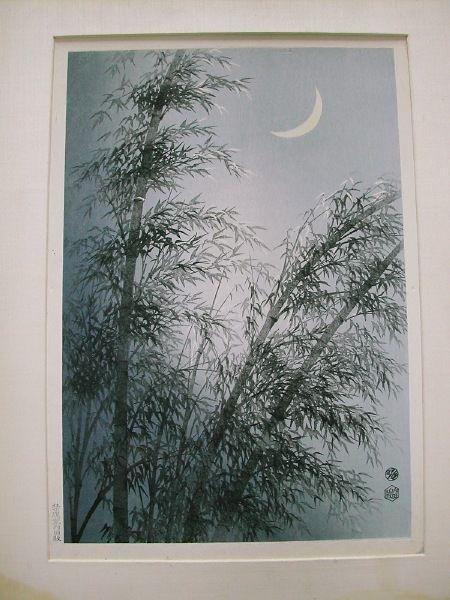
Bamboo trees with a crescent moon
Not set
Woodblock print
Featured in Collections
Curated cross-cuts that include this print.
Frequently Asked Questions
Kiyozumi Garden in Moonlight was created by Kawase Hasui (川瀬巴水) in January 1938.
Kiyozumi Garden in Moonlight uses Bokashi, on woodblock print, ink and color on paper.
Kiyozumi Garden in Moonlight was published by Watanabe Shozaburo (January 1938).
Kiyozumi Garden in Moonlight depicts moonlight, night scenes, and gardens.
Kiyozumi Garden in Moonlight measures 35.4 × 23.2 cm (Oban format).