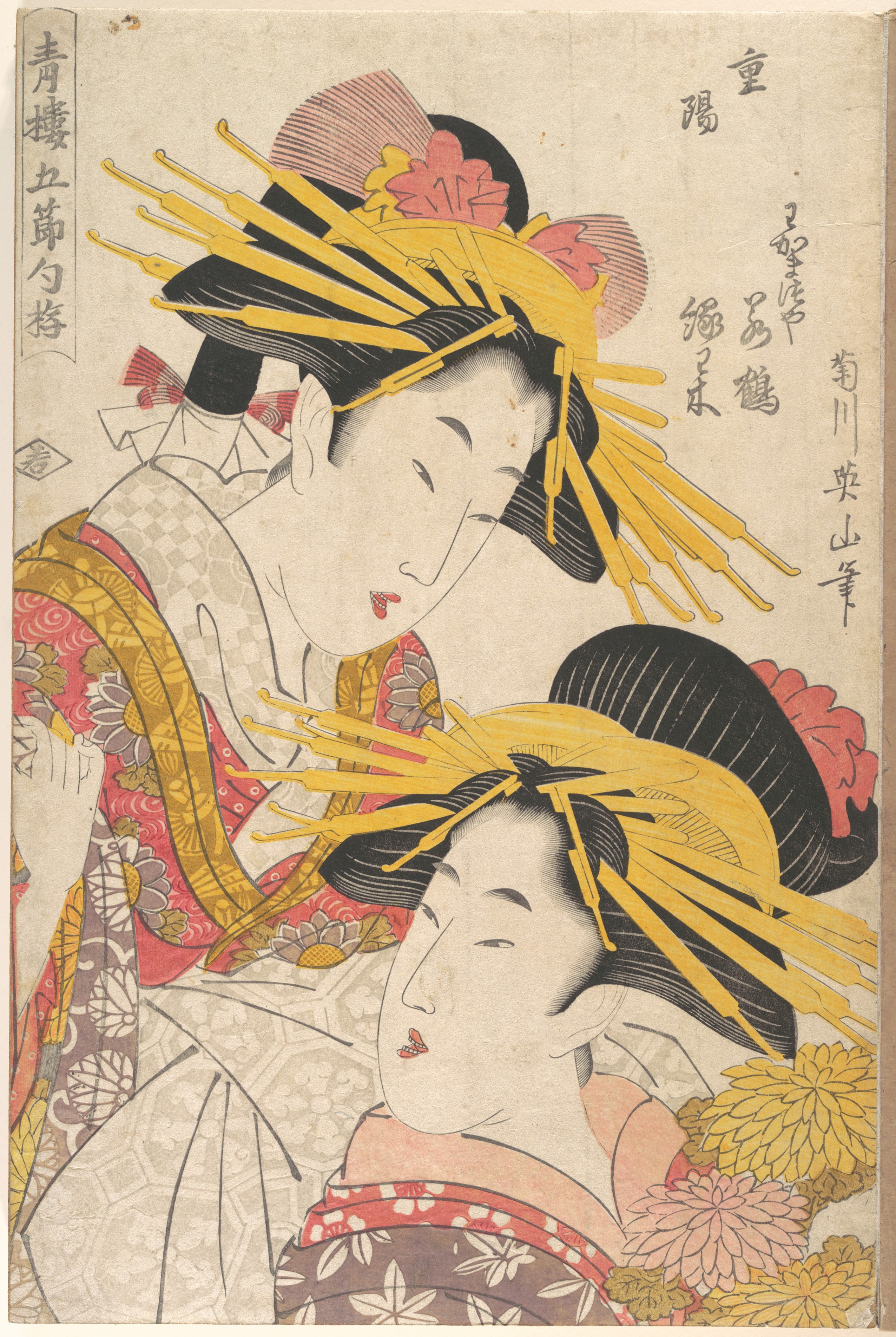
Album of Prints by Kikugawa Eizan, Utagawa Kunisada, and Utagawa Kunimaru
- Date:
- 19th century
- Medium:
- Album of 24 woodblock prints; ink and color on paper
- Source:
- Metropolitan Museum of Art
Description
Held by the Metropolitan Museum of Art and given a working date of about 1800, this album of prints by Kikugawa Eizan, Utagawa Kunisada, and Utagawa Kunimaru gathers designs from three of the leading bijin-ga and yakusha-e draftsmen working in Edo at the turn of the nineteenth century. Albums of this kind — bound or pasted compilations of single sheets — were the principal means by which collectors of the late Edo period preserved their woodblock prints from the wear of unbound storage, and they also document patterns of patronage and taste. Kikukawa Eizan's inclusion alongside Kunisada and Kunimaru reflects his status as the leading bijin-ga specialist of the period; the Utagawa-school masters dominated actor prints, while the Kikukawa school led the parallel market for prints of beautiful women. Eizan's contributions show the slender, decoratively dressed figures that defined Edo bijin-ga in the Bunka and Bunsei eras, with elongated necks, small mouths, and densely patterned outer robes. The album format invites close comparison across hands and subjects, and prints of this kind often preserve impressions in remarkably good condition because they were rarely exposed to light. The Metropolitan Museum of Art's catalog record, which includes a description of the binding and contents, can be consulted at https://www.metmuseum.org/art/collection/search/36682. The album is a useful resource for tracing how Eizan's Kikukawa school designs circulated alongside the work of Utagawa-school contemporaries.
More Prints by Kikukawa Eizan

The Theater District in Sakai-cho (Sakai cho shibai), from the "Fashionable Eight Views of the Eastern Capital (Furyu Toto hakkei)"
c. 1824/29
Color woodblock print; oban

Beauty standing beside morning glories
c. 1814/17
Color woodblock print; center sheet of oban triptych (right sheet: 1963.613)

Returning Sails at Yabase (Yabase kihan), from the series "Fashionable Eight Views of Omi (Furyu Omi hakkei)"
c. 1814/17
Color woodblock print; oban

Enjoying the Evening Cool at Ryogoku Bridge (Ryogokubashi noryo), from the series "Fashionable Eight Views of Edo (Furyu Edo hakkei)"
early 19th century
Color woodblock print; oban
Frequently Asked Questions
Album of Prints by Kikugawa Eizan, Utagawa Kunisada, and Utagawa Kunimaru was created by Kikukawa Eizan (菊川英山) in 19th century.