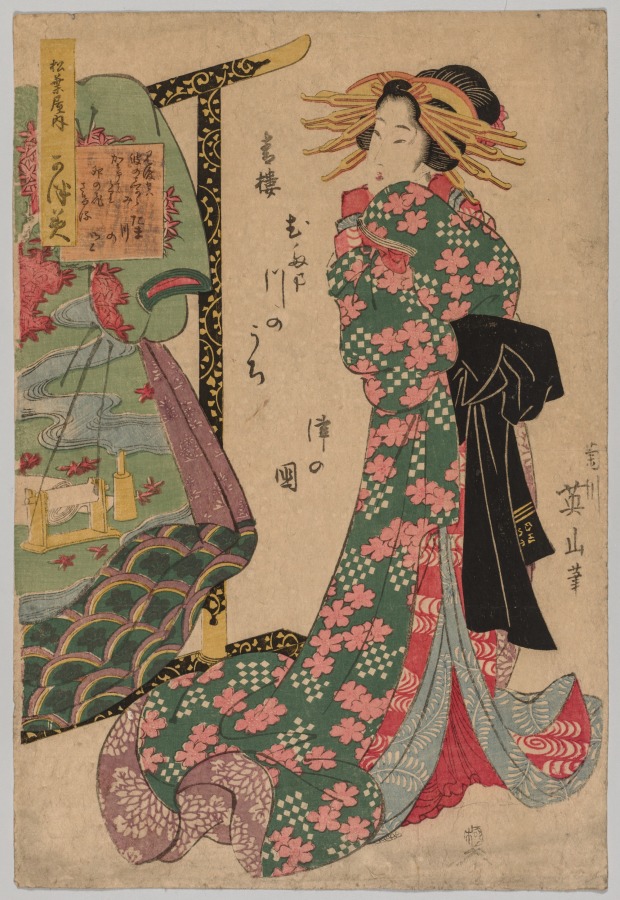
Courtesan Beside Kimono Rack
- Date:
- 1787–1867
- Medium:
- color woodblock print
- Source:
- Cleveland Museum of Art
Description
This print of a courtesan beside a kimono rack, dated to 1787 in the Cleveland Museum of Art's records, exemplifies the intimate domestic vignettes that became central to Kikukawa Eizan's contribution to Edo bijin-ga. A solitary woman of the pleasure quarters pauses beside a wooden rack draped with patterned silks, a quiet pictorial pretext that allowed Eizan to set the slender, willowy figure he favored against the dense surface ornament of textile design. The composition reflects the studio practices of the Kikukawa school, which Eizan founded and led during the late Bunka and Bunsei eras. Trained initially in the Kano tradition before turning to ukiyo-e, Eizan inherited the legacy of Kitagawa Utamaro's bijin-ga and refined it into an idiom more elongated, more decorative, and more attentive to the costume than to the psychological interior of his subjects. Here the kimono rack functions almost as a second portrait, the garment a parallel object of contemplation. Surface patterns are printed in tight register, the silhouette curves with a calligraphic poise, and the negative space around the figure is left largely unmodulated so that costume and pose hold the eye. As the dominant printmaker of beauties in the years immediately before the rise of Keisai Eisen and Utagawa Kunisada, Eizan formed a stylistic bridge between Utamaro's late manner and the more decorative bijin-ga of the 1820s. The Cleveland Museum of Art preserves this design as part of its substantial Eizan holdings, providing scholars with documentation of the artist's early engagement with the courtesan-and-interior format. The work's accession record can be consulted at https://clevelandart.org/art/1943.36.
More Prints by Kikukawa Eizan

The Theater District in Sakai-cho (Sakai cho shibai), from the "Fashionable Eight Views of the Eastern Capital (Furyu Toto hakkei)"
c. 1824/29
Color woodblock print; oban

Beauty standing beside morning glories
c. 1814/17
Color woodblock print; center sheet of oban triptych (right sheet: 1963.613)

Returning Sails at Yabase (Yabase kihan), from the series "Fashionable Eight Views of Omi (Furyu Omi hakkei)"
c. 1814/17
Color woodblock print; oban

Enjoying the Evening Cool at Ryogoku Bridge (Ryogokubashi noryo), from the series "Fashionable Eight Views of Edo (Furyu Edo hakkei)"
early 19th century
Color woodblock print; oban
Frequently Asked Questions
Courtesan Beside Kimono Rack was created by Kikukawa Eizan (菊川英山) in 1787–1867.