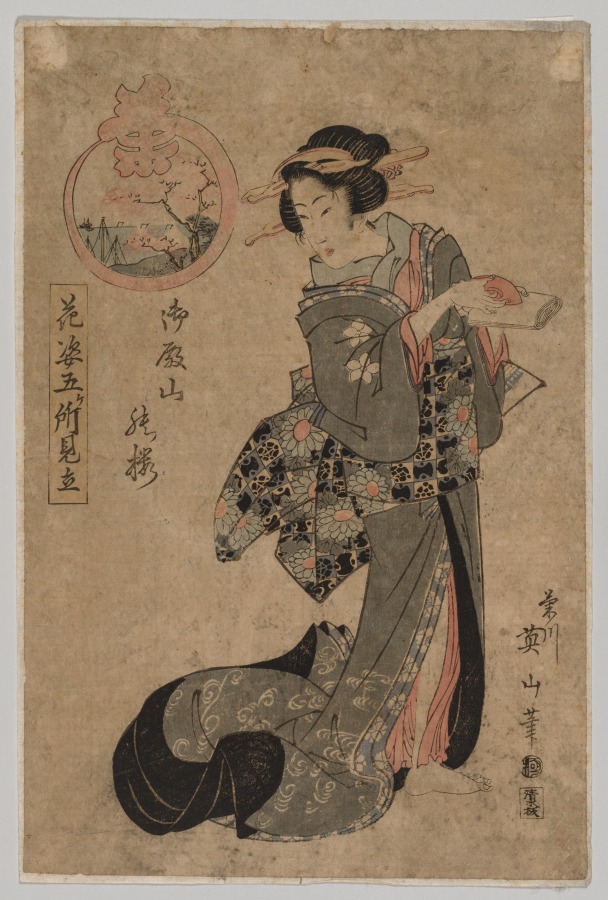
Courtesan with Sake Cup and Scroll
- Date:
- 1787–1867
- Medium:
- color woodblock print
- Source:
- Cleveland Museum of Art
Description
Courtesan with Sake Cup and Scroll, dated to 1787 in the Cleveland Museum of Art's records, joins a small group of single-figure bijin-ga in which Kikukawa Eizan combines props of leisure and learning into a composite portrait of pleasure-quarter cultivation. The courtesan holds a lacquered sake cup in one hand and a partly opened scroll in the other, twin attributes that signal her membership in the literate, accomplished tier of Yoshiwara women — a tier whose patrons paid for poetry and conversation as much as for company. Eizan's drawing here is supple and unforced, with the elongated proportions and pale, oval face that define his contribution to Edo bijin-ga. The Kikukawa school, founded by Eizan and continued by pupils including Keisai Eisen, dominated the bijin-ga market between the late 1800s and the early 1820s by producing exactly this kind of staged, attribute-laden portrait of named courtesans and idealized beauties. The combination of sake cup and scroll specifically evokes the entertainment customs of the upper Yoshiwara, where elaborately staged drinking parties were interleaved with the recitation of waka and Chinese poetry. The Cleveland Museum of Art's record, with technical and provenance information, may be consulted at https://clevelandart.org/art/1943.34, where the print is preserved as part of the museum's extensive holdings of Eizan and his immediate followers.
More Prints by Kikukawa Eizan

The Theater District in Sakai-cho (Sakai cho shibai), from the "Fashionable Eight Views of the Eastern Capital (Furyu Toto hakkei)"
c. 1824/29
Color woodblock print; oban

Beauty standing beside morning glories
c. 1814/17
Color woodblock print; center sheet of oban triptych (right sheet: 1963.613)

Returning Sails at Yabase (Yabase kihan), from the series "Fashionable Eight Views of Omi (Furyu Omi hakkei)"
c. 1814/17
Color woodblock print; oban

Enjoying the Evening Cool at Ryogoku Bridge (Ryogokubashi noryo), from the series "Fashionable Eight Views of Edo (Furyu Edo hakkei)"
early 19th century
Color woodblock print; oban
Frequently Asked Questions
Courtesan with Sake Cup and Scroll was created by Kikukawa Eizan (菊川英山) in 1787–1867.