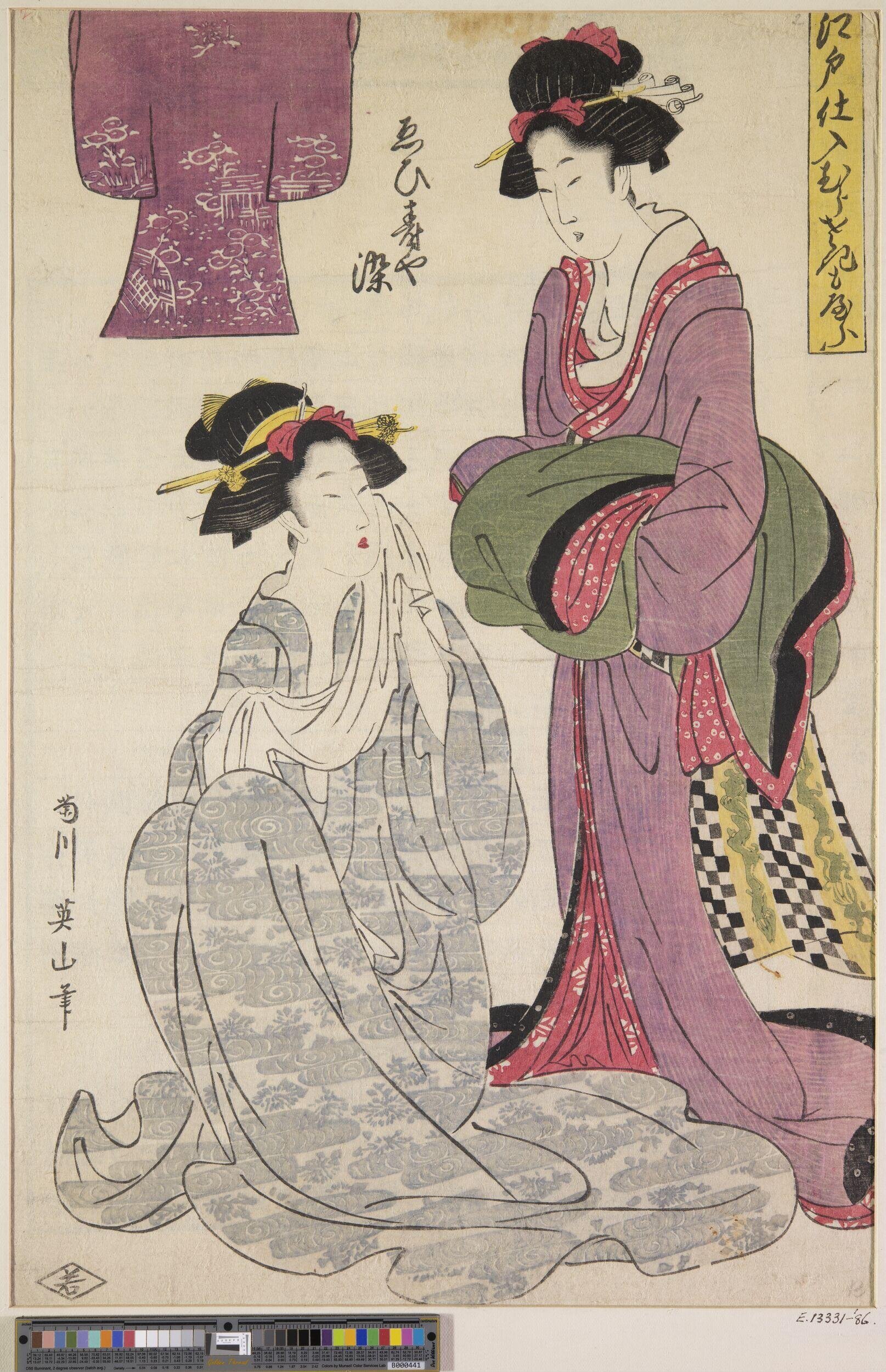
'Dyed Works of the Ebisuya Store'
- Date:
- 1807-1809
- Medium:
- Source:
- Victoria and Albert Museum
Description
Dyed Works of the Ebisuya Store, dated to 1807 in the Victoria and Albert Museum's catalog, is one of the explicitly commercial designs that Kikukawa Eizan produced for Edo dry-goods merchants. The Ebisuya was a textile and dye shop, and prints of this kind functioned both as bijin-ga and as advertisement: the courtesans, geisha, or fashionable townswomen depicted wear the establishment's most desirable patterns, and the shop name is incorporated into the cartouche. Edo's woodblock print market and its merchant economy were tightly interwoven, and dry-goods merchants frequently commissioned designs from the leading bijin-ga draftsmen — Kitagawa Utamaro before his death in 1806, and then Eizan and his Kikukawa school pupils through the Bunka and Bunsei eras. The 1807 date places this print at the cusp of Eizan's takeover of the bijin-ga market. His figures here have the slender, tapering bodies and densely patterned outer robes that would define the Kikukawa style for the next two decades. The Edo bijin-ga had always blurred the line between idealized portrait and commercial display; this Ebisuya print makes the conjunction explicit. The Victoria and Albert Museum's catalog record, with details of medium and acquisition, may be consulted at https://collections.vam.ac.uk/item/O421937.
More Prints by Kikukawa Eizan

The Theater District in Sakai-cho (Sakai cho shibai), from the "Fashionable Eight Views of the Eastern Capital (Furyu Toto hakkei)"
c. 1824/29
Color woodblock print; oban

Beauty standing beside morning glories
c. 1814/17
Color woodblock print; center sheet of oban triptych (right sheet: 1963.613)

Returning Sails at Yabase (Yabase kihan), from the series "Fashionable Eight Views of Omi (Furyu Omi hakkei)"
c. 1814/17
Color woodblock print; oban

Enjoying the Evening Cool at Ryogoku Bridge (Ryogokubashi noryo), from the series "Fashionable Eight Views of Edo (Furyu Edo hakkei)"
early 19th century
Color woodblock print; oban
Frequently Asked Questions
'Dyed Works of the Ebisuya Store' was created by Kikukawa Eizan (菊川英山) in 1807-1809.