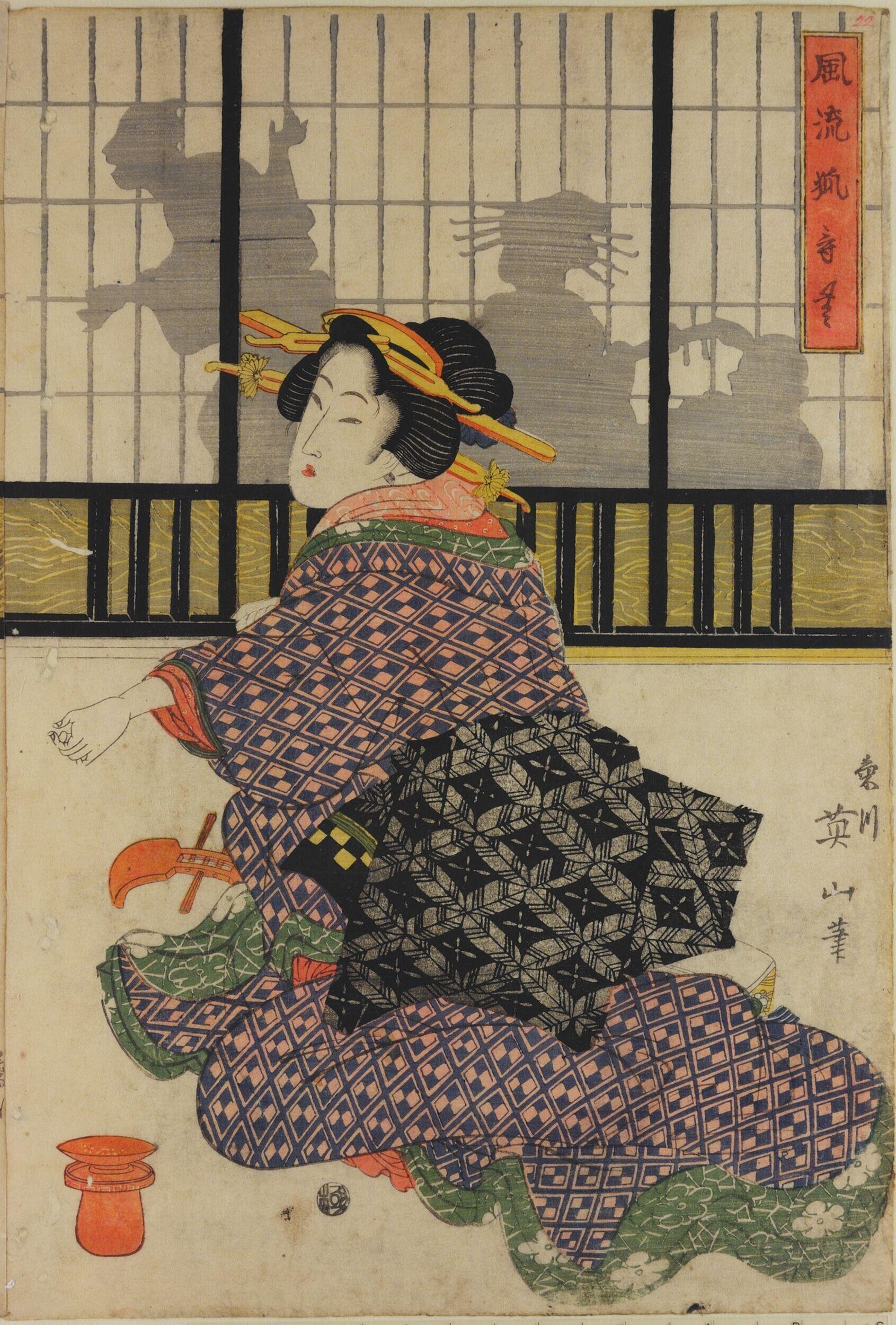
Fashionable Kitsune-ken (‘Fox Fist’) Game
- Date:
- Circa 1820
- Medium:
- Source:
- Victoria and Albert Museum
Description
Fashionable Kitsune-ken (Fox Fist) Game, dated to about 1820 in the Victoria and Albert Museum's catalog, depicts a parlor pastime that animated the social life of the Edo pleasure quarters. Kitsune-ken, a three-way variant of the rock-paper-scissors family in which the hand signs for fox, hunter, and village headman trumped one another in a closed cycle, was a favorite drinking game; players who lost paid a sake forfeit. Kikukawa Eizan stages the game as an opportunity for the most elegant figural play of his Bunsei-era practice. The women's slim torsos lean toward one another with mirrored grace, fingers caught mid-gesture in the moment that decides the round. As an Edo bijin-ga subject the print belongs to a long lineage of contest pictures stretching back through Utamaro, but Eizan, working at the head of the Kikukawa school by this date, gives it a distinctively decorative cast. Pattern density across the kimono increases, the women's necks elongate, and the line takes on the wiry tension that Keisai Eisen would carry further in the 1820s and 1830s. The print exemplifies how Eizan's studio kept the bijin-ga tradition commercially alive in the years before Kunisada's dominance. The Victoria and Albert Museum's record for the sheet, including its provenance details, may be consulted at https://collections.vam.ac.uk/item/O69327.
More Prints by Kikukawa Eizan

The Theater District in Sakai-cho (Sakai cho shibai), from the "Fashionable Eight Views of the Eastern Capital (Furyu Toto hakkei)"
c. 1824/29
Color woodblock print; oban

Beauty standing beside morning glories
c. 1814/17
Color woodblock print; center sheet of oban triptych (right sheet: 1963.613)

Returning Sails at Yabase (Yabase kihan), from the series "Fashionable Eight Views of Omi (Furyu Omi hakkei)"
c. 1814/17
Color woodblock print; oban

Enjoying the Evening Cool at Ryogoku Bridge (Ryogokubashi noryo), from the series "Fashionable Eight Views of Edo (Furyu Edo hakkei)"
early 19th century
Color woodblock print; oban
Frequently Asked Questions
Fashionable Kitsune-ken (‘Fox Fist’) Game was created by Kikukawa Eizan (菊川英山) in Circa 1820.