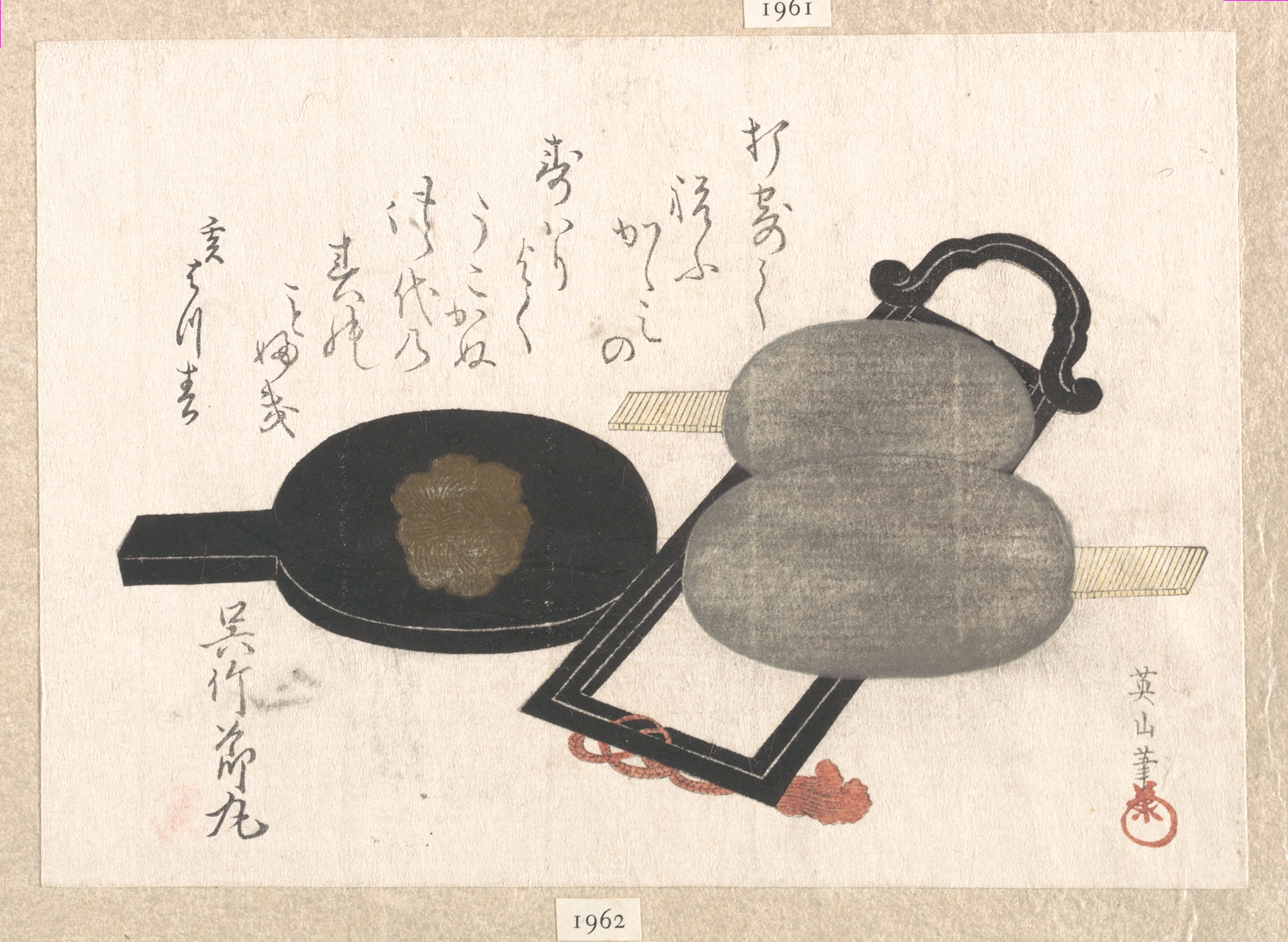
Mirror and Stand
- Date:
- probably 1815
- Medium:
- Woodblock print (surimono); ink and color on paper
- Source:
- Metropolitan Museum of Art
Description
Mirror and Stand, held by the Metropolitan Museum of Art and given a working date of about 1815, depicts the most ordinary of toilet objects — a polished bronze mirror mounted in a small lacquered stand — as the focus for an Edo bijin-ga reflection. Kikukawa Eizan, by this date well established at the head of the Kikukawa school, returned again and again to mirrors as compositional devices. A mirror permitted him to show a woman's face twice within a single sheet, frontally in the disk of the mirror and in profile or three-quarter view beyond it, doubling the bijin-ga's central object of attention. In this design the mirror and stand become the explicit subject; the woman who would have used them is suggested rather than depicted. Such still-life-leaning compositions were uncommon in mainstream bijin-ga but fit naturally into the surimoku-like or surimono-influenced publications that Eizan produced in the 1810s for connoisseurs interested in the accoutrements of urban life. The careful printing of the mirror's polished surface and the lacquered stand showcases the Kikukawa school's command of the colored woodblock medium during the height of its technical sophistication. The Metropolitan Museum of Art's catalog record can be consulted at https://www.metmuseum.org/art/collection/search/54537. The print is a quiet but precise example of the way Kikukawa Eizan's studio expanded the field of Edo bijin-ga to include the objects that defined a woman's daily routines.
More Prints by Kikukawa Eizan

The Theater District in Sakai-cho (Sakai cho shibai), from the "Fashionable Eight Views of the Eastern Capital (Furyu Toto hakkei)"
c. 1824/29
Color woodblock print; oban

Beauty standing beside morning glories
c. 1814/17
Color woodblock print; center sheet of oban triptych (right sheet: 1963.613)

Returning Sails at Yabase (Yabase kihan), from the series "Fashionable Eight Views of Omi (Furyu Omi hakkei)"
c. 1814/17
Color woodblock print; oban

Enjoying the Evening Cool at Ryogoku Bridge (Ryogokubashi noryo), from the series "Fashionable Eight Views of Edo (Furyu Edo hakkei)"
early 19th century
Color woodblock print; oban
Frequently Asked Questions
Mirror and Stand was created by Kikukawa Eizan (菊川英山) in probably 1815.