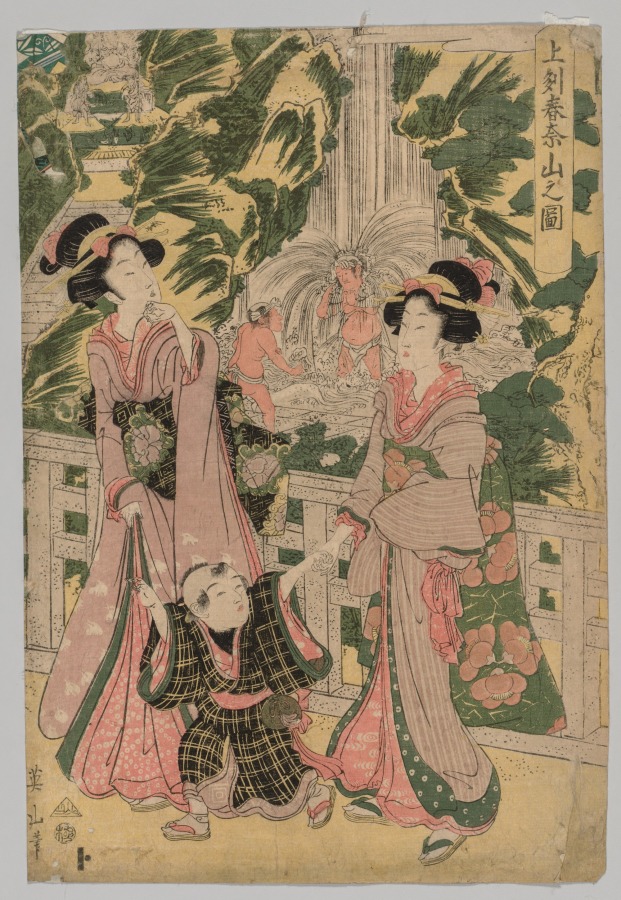
Mount Haruna in Kozuke Province
- Date:
- c. 1830s
- Medium:
- color woodblock print
- Source:
- Cleveland Museum of Art
Description
Mount Haruna in Kozuke Province, dated about 1830 in the Cleveland Museum of Art's records, occupies an unusual place in Kikukawa Eizan's oeuvre because it is a landscape — a category Eizan engaged only rarely. Mount Haruna, a volcanic peak in what is now Gunma Prefecture, was a long-standing pilgrimage destination known for its lake-filled crater and its shrine. The 1830 dating places this design at a period when the landscape print, propelled by Katsushika Hokusai's Thirty-six Views of Mount Fuji and Utagawa Hiroshige's emerging series, was rapidly reshaping the ukiyo-e market. Eizan, by then in the later phase of his career and the head of an established Kikukawa school, appears to have ventured into the landscape genre in response to changing demand. His drawing of the mountain retains traces of the bijin-ga style: the contour lines are calligraphically inflected, the printing of distance is articulated in soft tonal bands, and the composition is held together by an attention to balanced silhouette rather than by the geometric construction Hokusai favored. The print therefore offers a useful index of how the leading Edo bijin-ga master adapted, or chose not to adapt, to the new landscape vogue. The Cleveland Museum of Art's record for the sheet may be consulted at https://clevelandart.org/art/1943.35, where it is held as part of the museum's broader Eizan collection.
More Prints by Kikukawa Eizan

The Theater District in Sakai-cho (Sakai cho shibai), from the "Fashionable Eight Views of the Eastern Capital (Furyu Toto hakkei)"
c. 1824/29
Color woodblock print; oban

Beauty standing beside morning glories
c. 1814/17
Color woodblock print; center sheet of oban triptych (right sheet: 1963.613)

Returning Sails at Yabase (Yabase kihan), from the series "Fashionable Eight Views of Omi (Furyu Omi hakkei)"
c. 1814/17
Color woodblock print; oban

Enjoying the Evening Cool at Ryogoku Bridge (Ryogokubashi noryo), from the series "Fashionable Eight Views of Edo (Furyu Edo hakkei)"
early 19th century
Color woodblock print; oban
Frequently Asked Questions
Mount Haruna in Kozuke Province was created by Kikukawa Eizan (菊川英山) in c. 1830s.