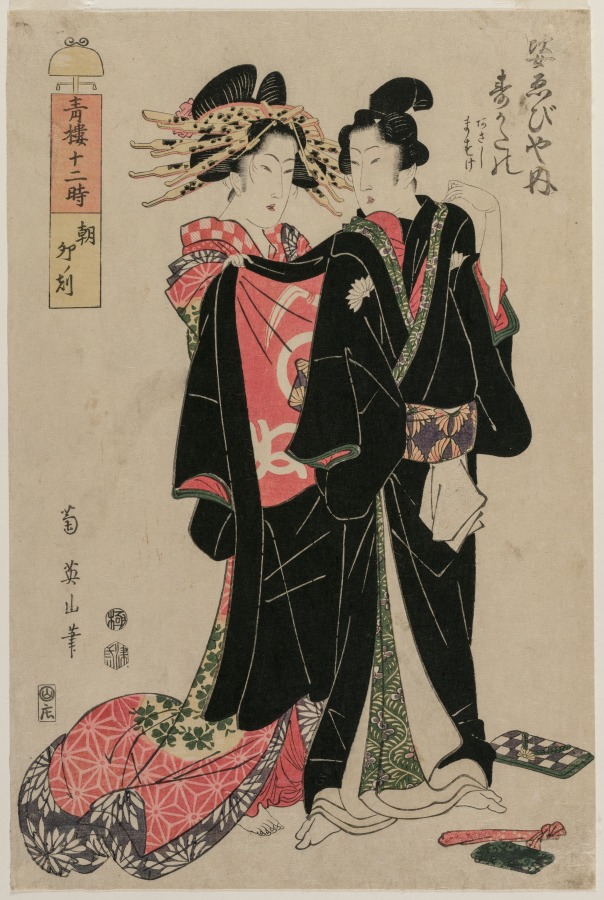
Sugatano of Sugata Ebisuya in the Morning, Hour of the Rabbit, from the series The Twelve Hours in the Pleasure Quarters
- Date:
- 1812
- Medium:
- Color woodblock print; ink and color on paper
- Source:
- Cleveland Museum of Art
Description
Sugatano of Sugata Ebisuya in the Morning, Hour of the Rabbit, dated 1812 in the Cleveland Museum of Art's records, belongs to Kikukawa Eizan's series The Twelve Hours in the Pleasure Quarters. The traditional Japanese day was divided not into twenty-four hours but into twelve double-hour periods named after the zodiac animals; the Hour of the Rabbit corresponds roughly to six o'clock in the morning, the moment when the night's revels in the Yoshiwara drew finally to a close and courtesans like Sugatano of the Ebisuya house could shed their formal attire and rest. Eizan's series adapts a venerable Edo bijin-ga conceit — the twelve hours mapped onto twelve courtesans — that Kitagawa Utamaro had famously used a generation earlier. Eizan's morning Sugatano is shown in the freshness of half-undress, with her elaborate hair partly loosened and her outer kimono shifted to expose a length of shoulder. The composition is built around the contrast of decorative pattern and bare skin, and the figure has the slim, elongated proportions characteristic of the Kikukawa school. As founder and head of that school Eizan dominated bijin-ga in the years between Utamaro's death and the rise of Keisai Eisen, and series like The Twelve Hours allowed him to display the named courtesans of the Yoshiwara — a key commercial appeal for Edo print buyers. The Cleveland Museum of Art's record for the print may be consulted at https://clevelandart.org/art/1985.303.
More Prints by Kikukawa Eizan

The Theater District in Sakai-cho (Sakai cho shibai), from the "Fashionable Eight Views of the Eastern Capital (Furyu Toto hakkei)"
c. 1824/29
Color woodblock print; oban

Beauty standing beside morning glories
c. 1814/17
Color woodblock print; center sheet of oban triptych (right sheet: 1963.613)

Returning Sails at Yabase (Yabase kihan), from the series "Fashionable Eight Views of Omi (Furyu Omi hakkei)"
c. 1814/17
Color woodblock print; oban

Enjoying the Evening Cool at Ryogoku Bridge (Ryogokubashi noryo), from the series "Fashionable Eight Views of Edo (Furyu Edo hakkei)"
early 19th century
Color woodblock print; oban
Frequently Asked Questions
Sugatano of Sugata Ebisuya in the Morning, Hour of the Rabbit, from the series The Twelve Hours in the Pleasure Quarters was created by Kikukawa Eizan (菊川英山) in 1812.