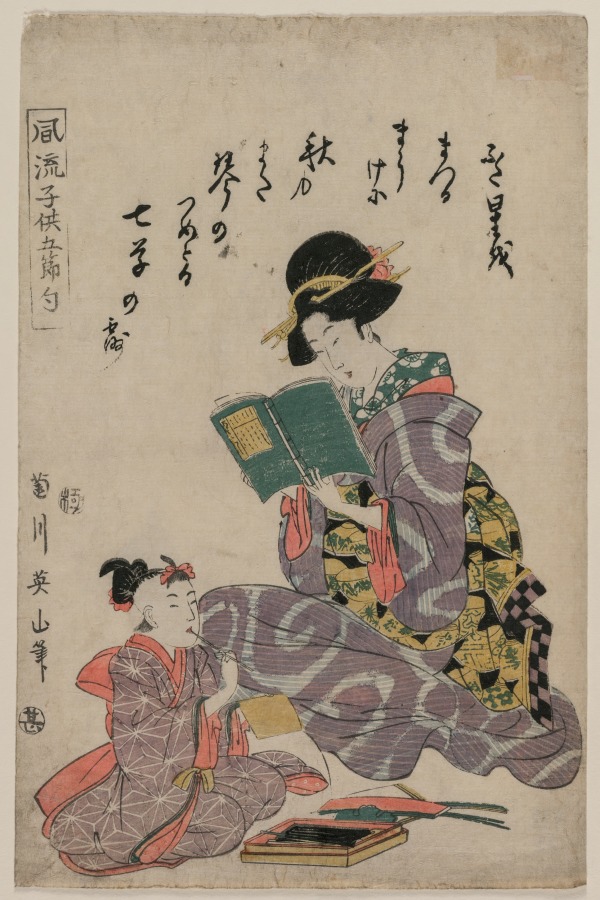
Tanabata, from the series Fashionable Children of the Five Festivals (Fūryū kodomo gosekku)
- Date:
- c. 1809–29
- Medium:
- Color woodblock print
- Source:
- Cleveland Museum of Art
Description
Tanabata, from the series Fashionable Children of the Five Festivals (Furyu kodomo gosekku), dated 1809 in the Cleveland Museum of Art's records, transposes the seventh-month star festival into the world of Kikukawa Eizan's Edo bijin-ga. The five festivals (gosekku) — the seventh day of the first, third, fifth, seventh, and ninth months — structured the ceremonial year of urban Japan, and Tanabata, on the seventh of the seventh, celebrated the once-yearly meeting of the cowherd and weaver stars across the Milky Way. Households hung strips of poetry from bamboo, and children dressed in their best. Eizan stages the festival as an occasion for elegant childhood ritual, casting a young figure in fashionable kimono beside the bamboo branches. The 'children' of the series title are pictured not as toddlers but as kamuro or wakaza — apprentice girls of the pleasure quarters whose elaborate dress mirrored the adult courtesans they would one day become. The series belongs to the Kikukawa school's broader project of mapping the urban calendar onto bijin-ga, and Eizan's slender figures, dense surface pattern, and carefully balanced negative space here are characteristic of his Bunka-era manner. The Cleveland Museum of Art's record for the print may be consulted at https://clevelandart.org/art/1943.32. The series provides useful documentation of how festival imagery was absorbed into the bijin-ga market.
More Prints by Kikukawa Eizan

The Theater District in Sakai-cho (Sakai cho shibai), from the "Fashionable Eight Views of the Eastern Capital (Furyu Toto hakkei)"
c. 1824/29
Color woodblock print; oban

Beauty standing beside morning glories
c. 1814/17
Color woodblock print; center sheet of oban triptych (right sheet: 1963.613)

Returning Sails at Yabase (Yabase kihan), from the series "Fashionable Eight Views of Omi (Furyu Omi hakkei)"
c. 1814/17
Color woodblock print; oban

Enjoying the Evening Cool at Ryogoku Bridge (Ryogokubashi noryo), from the series "Fashionable Eight Views of Edo (Furyu Edo hakkei)"
early 19th century
Color woodblock print; oban
More Children Prints
Frequently Asked Questions
Tanabata, from the series Fashionable Children of the Five Festivals (Fūryū kodomo gosekku) was created by Kikukawa Eizan (菊川英山) in c. 1809–29.
Tanabata, from the series Fashionable Children of the Five Festivals (Fūryū kodomo gosekku) depicts children.