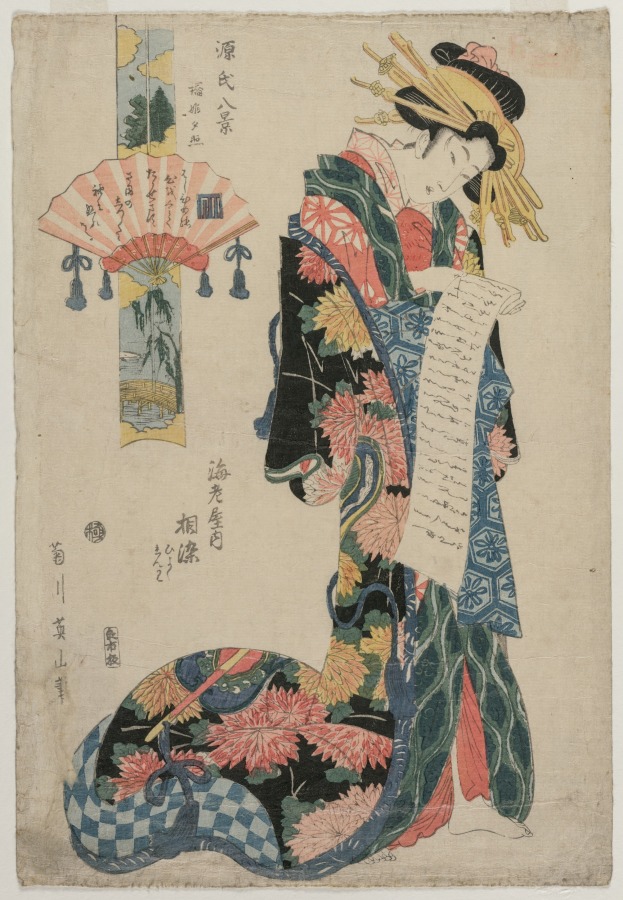
The Courtesan Aizome of the Ebiya (From the series Eight Views of the Tale of Genji)
- Date:
- c. late 1800s
- Medium:
- color woodblock print
- Source:
- Cleveland Museum of Art
Description
The Courtesan Aizome of the Ebiya, from the series Eight Views of the Tale of Genji, dated about 1800 in the Cleveland Museum of Art's catalog, exemplifies the mitate (parodic or analogical) approach that Kikukawa Eizan and the Kikukawa school used to integrate classical literature into Edo bijin-ga. The series adapts the Eight Views convention — itself a Chinese landscape conceit absorbed into Japanese poetry and painting centuries earlier — to episodes from The Tale of Genji, then transposes each episode into the figure of a named courtesan of the Yoshiwara. Aizome of the Ebiya stands in for one of Genji's eight scenes; the joke and the pleasure of the print depend on the viewer's ability to recognize both the literary source and the contemporary courtesan, and to enjoy the play between them. Eizan was a leading practitioner of these classical-quarter mitate. His figures, with their long necks, small heads, and densely patterned kimono, conferred Edo modernity on the most canonical of Heian-era narratives, and the format flattered the literacy of his patrons. The Cleveland Museum of Art preserves the print as part of its extensive Eizan and Kikukawa school holdings; its record may be consulted at https://clevelandart.org/art/1943.31. The series remains a useful case study in how the late Edo bijin-ga negotiated the boundary between popular pleasure-quarter celebrity and classical Heian reference.
More Prints by Kikukawa Eizan

The Theater District in Sakai-cho (Sakai cho shibai), from the "Fashionable Eight Views of the Eastern Capital (Furyu Toto hakkei)"
c. 1824/29
Color woodblock print; oban

Beauty standing beside morning glories
c. 1814/17
Color woodblock print; center sheet of oban triptych (right sheet: 1963.613)

Returning Sails at Yabase (Yabase kihan), from the series "Fashionable Eight Views of Omi (Furyu Omi hakkei)"
c. 1814/17
Color woodblock print; oban

Enjoying the Evening Cool at Ryogoku Bridge (Ryogokubashi noryo), from the series "Fashionable Eight Views of Edo (Furyu Edo hakkei)"
early 19th century
Color woodblock print; oban
Frequently Asked Questions
The Courtesan Aizome of the Ebiya (From the series Eight Views of the Tale of Genji) was created by Kikukawa Eizan (菊川英山) in c. late 1800s.