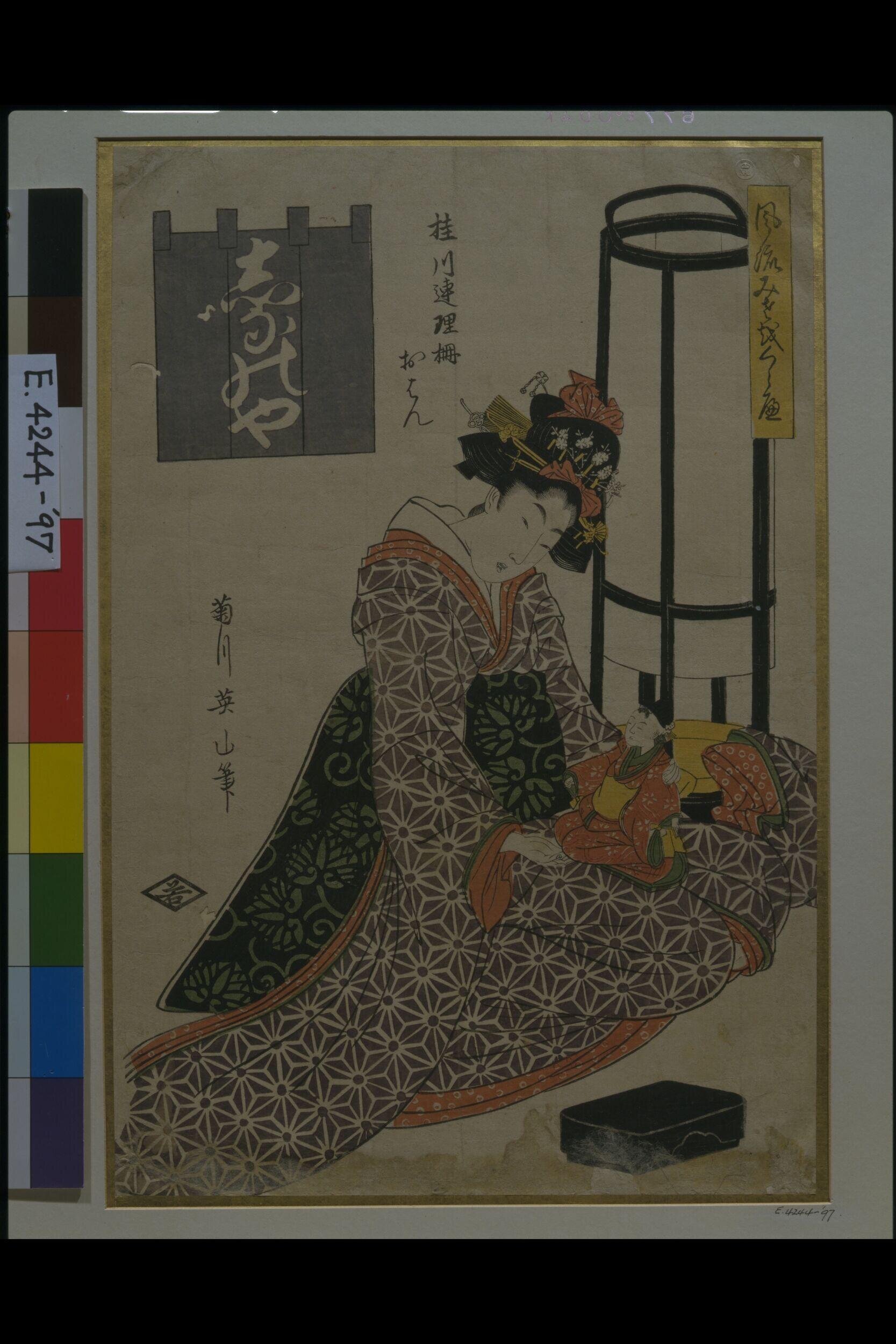
The Joruri character Ohan with a doll
- Date:
- ca. 1810
- Medium:
- Source:
- Victoria and Albert Museum
Description
The Joruri Character Ohan with a Doll, dated to about 1810 in the Victoria and Albert Museum's catalog, draws on the puppet-theater repertoire (joruri) that supplied so many of the dramatic plots also adapted into kabuki. Ohan, a young woman whose love affair with the older merchant Choemon ends in their double suicide, appears in the 1776 joruri Katsuragawa Renri no Shigarami and in successive kabuki adaptations; she is the prototype of the doomed female lover in late Edo popular theater. Kikukawa Eizan stages her as an Edo bijin-ga, her body slim and her head turned with calligraphic delicacy. The doll she holds carries a freight of meaning. In Edo popular culture dolls served both as toys and as charged ritual objects — substitutes for the dead, vessels for sorrow, and, in the case of theatrical heroines, signs of the youth Ohan was about to lose. Eizan's design therefore plays bijin-ga conventions against the tragic plot of the joruri, the elegantly decorated kimono acting as a vehicle for narrative tension. As the head of the Kikukawa school, Eizan supplied an Edo market eager for such literary mitate, and his prints helped sustain the visibility of the joruri repertoire during a period when kabuki was increasingly its dominant performance form. The Victoria and Albert Museum's catalog record may be consulted at https://collections.vam.ac.uk/item/O71697.
More Prints by Kikukawa Eizan

The Theater District in Sakai-cho (Sakai cho shibai), from the "Fashionable Eight Views of the Eastern Capital (Furyu Toto hakkei)"
c. 1824/29
Color woodblock print; oban

Beauty standing beside morning glories
c. 1814/17
Color woodblock print; center sheet of oban triptych (right sheet: 1963.613)

Returning Sails at Yabase (Yabase kihan), from the series "Fashionable Eight Views of Omi (Furyu Omi hakkei)"
c. 1814/17
Color woodblock print; oban

Enjoying the Evening Cool at Ryogoku Bridge (Ryogokubashi noryo), from the series "Fashionable Eight Views of Edo (Furyu Edo hakkei)"
early 19th century
Color woodblock print; oban
Frequently Asked Questions
The Joruri character Ohan with a doll was created by Kikukawa Eizan (菊川英山) in ca. 1810.