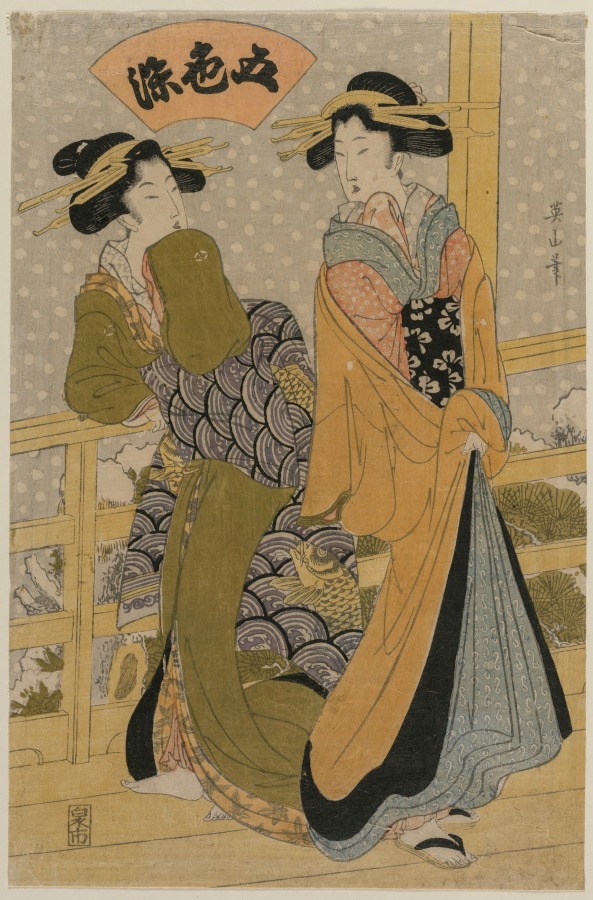
Two Courtesans on a Balcony (From the series Five Colors of Ink)
- Date:
- c. early 1810s
- Medium:
- color woodblock print
- Source:
- Cleveland Museum of Art
Description
Two Courtesans on a Balcony, from the series Five Colors of Ink, dated about 1810 in the Cleveland Museum of Art's records, applies a Chinese-derived chromatic theory to Kikukawa Eizan's Edo bijin-ga. The Chinese ink-painting tradition spoke of five 'colors' produced by a single black ink — densities of black, dark, medium, light, and pale — each calibrated by the dilution of the brush. Eizan's series turns the concept into a five-print survey of pleasure-quarter beauties, each sheet using a dominant tonality or pictorial mood to stand for one of the five inks. Two Courtesans on a Balcony places its subjects on the second-story railing of a Yoshiwara house, the two women angled toward one another in a balletic exchange of glances that organizes the composition. The slim bodies, narrow shoulders, and densely patterned outer robes are signatures of the Kikukawa school style during its commercial peak. The view from the balcony — a vantage point above the street but below the rooflines — was a stock setting in late-Edo bijin-ga because it allowed the courtesans to be shown in full formal attire and in informal repose at the same time. The Cleveland Museum of Art's record for the print, with provenance and condition notes, may be consulted at https://clevelandart.org/art/1940.1048. The series provides a useful index of how Eizan absorbed continental theory into Edo print conventions.
More Prints by Kikukawa Eizan

The Theater District in Sakai-cho (Sakai cho shibai), from the "Fashionable Eight Views of the Eastern Capital (Furyu Toto hakkei)"
c. 1824/29
Color woodblock print; oban

Beauty standing beside morning glories
c. 1814/17
Color woodblock print; center sheet of oban triptych (right sheet: 1963.613)

Returning Sails at Yabase (Yabase kihan), from the series "Fashionable Eight Views of Omi (Furyu Omi hakkei)"
c. 1814/17
Color woodblock print; oban

Enjoying the Evening Cool at Ryogoku Bridge (Ryogokubashi noryo), from the series "Fashionable Eight Views of Edo (Furyu Edo hakkei)"
early 19th century
Color woodblock print; oban
Frequently Asked Questions
Two Courtesans on a Balcony (From the series Five Colors of Ink) was created by Kikukawa Eizan (菊川英山) in c. early 1810s.