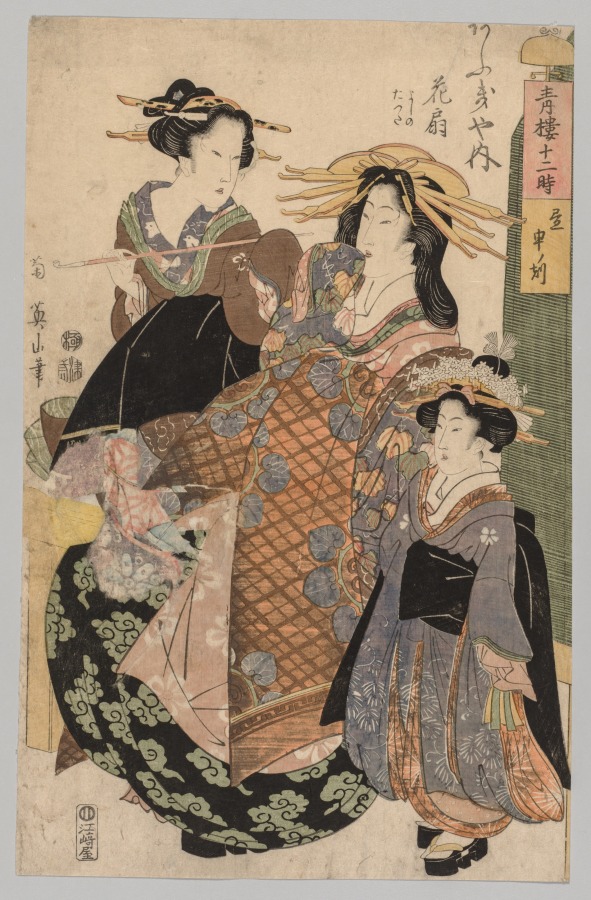
Two Women and a Girl
- Date:
- 1800–1829
- Medium:
- color woodblock print
- Source:
- Cleveland Museum of Art
Description
Two Women and a Girl, held by the Cleveland Museum of Art and assigned a working date of 1800, gathers three figures into the compact intergenerational grouping that Kikukawa Eizan returned to repeatedly across his career. A young attendant or daughter stands between two adult women, the trio arranged in a frieze-like stack that allowed Eizan to play three patterned kimono against one another within a tight vertical format. This kind of small-cast group portrait belongs squarely to the Edo bijin-ga tradition the Kikukawa school did so much to perpetuate. Where Kitagawa Utamoro's late beauties had emphasized facial individuation and shifts of mood, Eizan and his pupils Keisai Eisen and Kikukawa Eishin tended toward typologies — the courtesan, the geisha, the young attendant — distinguished primarily by hairstyle, comb placement, and the elaboration of the kimono. The slender, tapering bodies and small, rounded heads here are signatures of Eizan's mature drawing. The careful rhyming of patterns across the three robes is characteristic of the Kikukawa school approach to print design, in which textile became a primary expressive vehicle. Eizan's prints in this vein were widely circulated in Edo and helped sustain the market for bijin-ga during the first two decades of the nineteenth century. The Cleveland Museum of Art preserves the impression and makes its catalog entry available at https://clevelandart.org/art/1940.719, where the record situates the print within the museum's holdings of late Edo woodblock prints. The work offers a quiet, domestic counterpoint to Eizan's more spectacular courtesan portraits.
More Prints by Kikukawa Eizan

The Theater District in Sakai-cho (Sakai cho shibai), from the "Fashionable Eight Views of the Eastern Capital (Furyu Toto hakkei)"
c. 1824/29
Color woodblock print; oban

Beauty standing beside morning glories
c. 1814/17
Color woodblock print; center sheet of oban triptych (right sheet: 1963.613)

Returning Sails at Yabase (Yabase kihan), from the series "Fashionable Eight Views of Omi (Furyu Omi hakkei)"
c. 1814/17
Color woodblock print; oban

Enjoying the Evening Cool at Ryogoku Bridge (Ryogokubashi noryo), from the series "Fashionable Eight Views of Edo (Furyu Edo hakkei)"
early 19th century
Color woodblock print; oban
More Children Prints
Frequently Asked Questions
Two Women and a Girl was created by Kikukawa Eizan (菊川英山) in 1800–1829.
Two Women and a Girl depicts children.