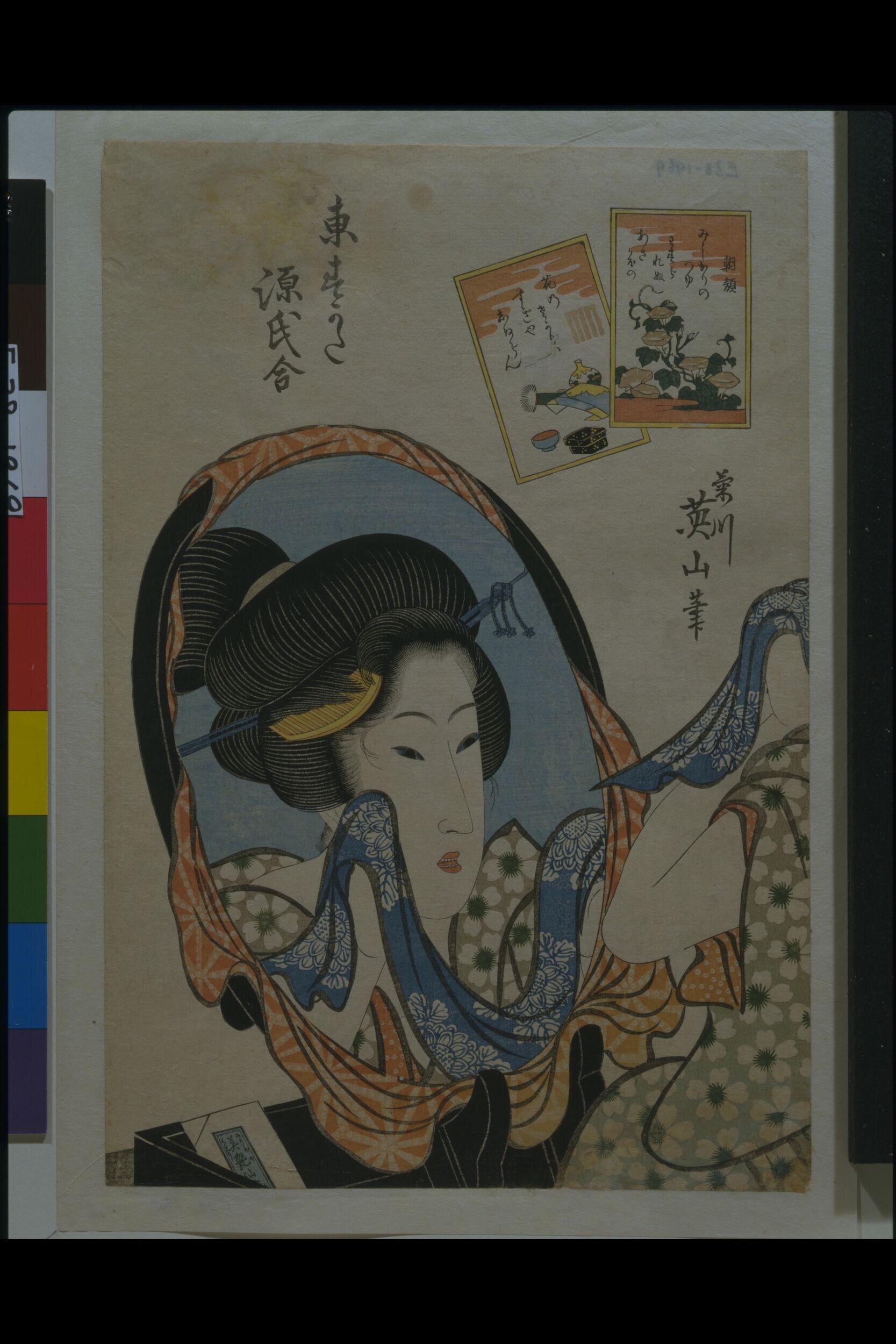
Woman at a Mirror
- Date:
- ca. 1820
- Medium:
- Source:
- Victoria and Albert Museum
Description
Woman at a Mirror, dated to about 1820 in the Victoria and Albert Museum's catalog, returns to one of the most enduring compositions in Edo bijin-ga: the beauty caught in the act of self-regard. Kikukawa Eizan, by this date the dominant bijin-ga draftsman of his generation, treats the mirror pose with the calligraphic elongation that defines his late style. The woman kneels before her low mirror stand; the mirror's polished bronze surface returns a partial second face, and the doubled image of the same figure becomes the engine of the design. The convention had been used by Suzuki Harunobu, Torii Kiyonaga, and Kitagawa Utamaro in turn, and each generation found new uses for it. Eizan and the Kikukawa school refined the format by elongating the body, sharpening the line, and increasing the density of textile pattern across the outer kimono until the mirror image read as the only undecorated zone in the composition. The pose carried a quiet erotic charge — the woman is absorbed in her own appearance and unaware of the viewer — that the format had carried since the eighteenth century. The Victoria and Albert Museum's catalog record for the sheet may be consulted at https://collections.vam.ac.uk/item/O71696. The print is a clear example of Kikukawa Eizan's mature Edo bijin-ga and of the Kikukawa school's command of the convention.
More Prints by Kikukawa Eizan

The Theater District in Sakai-cho (Sakai cho shibai), from the "Fashionable Eight Views of the Eastern Capital (Furyu Toto hakkei)"
c. 1824/29
Color woodblock print; oban

Beauty standing beside morning glories
c. 1814/17
Color woodblock print; center sheet of oban triptych (right sheet: 1963.613)

Returning Sails at Yabase (Yabase kihan), from the series "Fashionable Eight Views of Omi (Furyu Omi hakkei)"
c. 1814/17
Color woodblock print; oban

Enjoying the Evening Cool at Ryogoku Bridge (Ryogokubashi noryo), from the series "Fashionable Eight Views of Edo (Furyu Edo hakkei)"
early 19th century
Color woodblock print; oban
Frequently Asked Questions
Woman at a Mirror was created by Kikukawa Eizan (菊川英山) in ca. 1820.