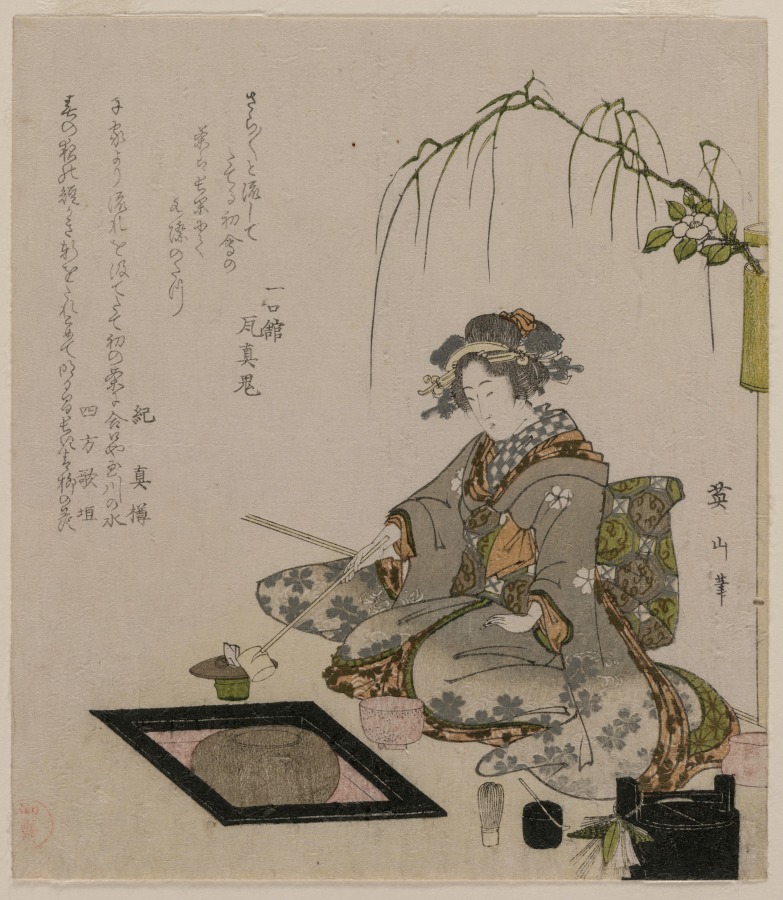
Woman Performing the Tea Ceremony
- Date:
- c. 1820
- Medium:
- color woodblock print
- Source:
- Cleveland Museum of Art
Description
Woman Performing the Tea Ceremony, dated to about 1815 in the Cleveland Museum of Art's records, joins Kikukawa Eizan's body of Edo bijin-ga that places its subjects within recognizable rites of refined urban culture. The tea ceremony (chanoyu), with its measured movements of whisk and bowl, made an unusually disciplined subject for an artist whose women more often appeared in the staged informality of the pleasure quarters. Here Eizan shows a single figure kneeling at her ceremonial brazier, her hands precisely placed in the act of preparing thick tea. The Kikukawa school of which Eizan was head specialized in this kind of single-figure ritual portrait, in which the elongated body, narrow shoulders, and small head register as much through silhouette as through detail. Eizan's command of textile pattern is evident in the printing of the woman's outer robe, where the layered colors are kept in clean register against the soft ground. The choice of the tea ceremony as subject reflects the broader penetration of chanoyu beyond the warrior elite and into the merchant culture that supplied much of Edo bijin-ga's audience. Tea practice had long been associated with female accomplishment, and prints like this one served readers who collected idealized images of cultivated women. The Cleveland Museum of Art's record for the print may be consulted at https://clevelandart.org/art/1921.321.
More Prints by Kikukawa Eizan

The Theater District in Sakai-cho (Sakai cho shibai), from the "Fashionable Eight Views of the Eastern Capital (Furyu Toto hakkei)"
c. 1824/29
Color woodblock print; oban

Beauty standing beside morning glories
c. 1814/17
Color woodblock print; center sheet of oban triptych (right sheet: 1963.613)

Returning Sails at Yabase (Yabase kihan), from the series "Fashionable Eight Views of Omi (Furyu Omi hakkei)"
c. 1814/17
Color woodblock print; oban

Enjoying the Evening Cool at Ryogoku Bridge (Ryogokubashi noryo), from the series "Fashionable Eight Views of Edo (Furyu Edo hakkei)"
early 19th century
Color woodblock print; oban
Frequently Asked Questions
Woman Performing the Tea Ceremony was created by Kikukawa Eizan (菊川英山) in c. 1820.