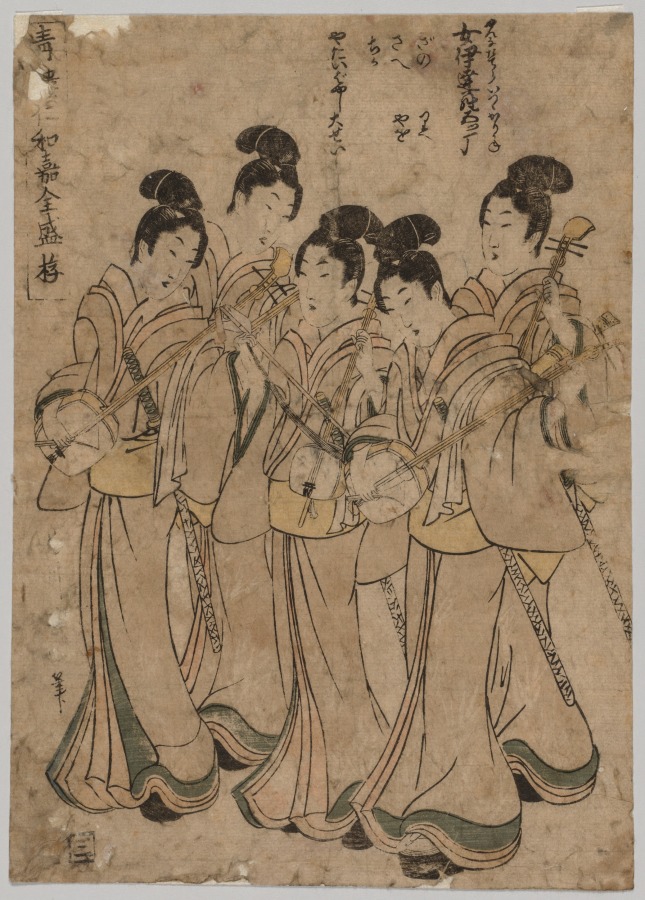
Young Women with Musical Instruments
- Date:
- 1787–1867
- Medium:
- color woodblock print
- Source:
- Cleveland Museum of Art
Description
Young Women with Musical Instruments, given a working date of 1787 in the Cleveland Museum of Art's records, gathers a small group of beauties around the instruments — shamisen, koto, or shoulder drum — that defined the accomplishments of well-trained women in the pleasure quarters and merchant households of Edo. The musical-instruments grouping was a long-running staple of Edo bijin-ga, used by Suzuki Harunobu, Torii Kiyonaga, and Kitagawa Utamaro in turn, and Kikukawa Eizan, working at the head of the Kikukawa school in the years after Utamaro's death, adapted the convention to his more elongated, more decoratively patterned style. The figures here arrange themselves into a loose triangle, the instruments providing both a narrative pretext and a system of diagonals that organizes the composition. Eizan's particular contribution lies in the combination: he keeps the genteel concord of the subject but tightens the line, slims the proportions, and amplifies the pattern density of the kimono until the surface ornament becomes a major visual event in its own right. The Kikukawa school's commercial success in the years between 1808 and the early 1820s rested on exactly this kind of carefully appointed group portrait of musical, poetic, and ceremonial accomplishment. The Cleveland Museum of Art's catalog record for the sheet, with provenance information, may be consulted at https://clevelandart.org/art/1943.43, where it is preserved as part of the museum's substantial Eizan holdings.
More Prints by Kikukawa Eizan

The Theater District in Sakai-cho (Sakai cho shibai), from the "Fashionable Eight Views of the Eastern Capital (Furyu Toto hakkei)"
c. 1824/29
Color woodblock print; oban

Beauty standing beside morning glories
c. 1814/17
Color woodblock print; center sheet of oban triptych (right sheet: 1963.613)

Returning Sails at Yabase (Yabase kihan), from the series "Fashionable Eight Views of Omi (Furyu Omi hakkei)"
c. 1814/17
Color woodblock print; oban

Enjoying the Evening Cool at Ryogoku Bridge (Ryogokubashi noryo), from the series "Fashionable Eight Views of Edo (Furyu Edo hakkei)"
early 19th century
Color woodblock print; oban
Frequently Asked Questions
Young Women with Musical Instruments was created by Kikukawa Eizan (菊川英山) in 1787–1867.