
Landscape
- Medium:
- Mokuhanga (Japanese woodblock)
- Image courtesy of
- Saru Gallery
Description
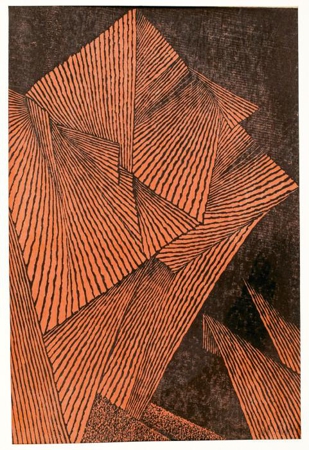
Landscape stands apart from Kinoshita Tomio's predominant focus on the human face, redirecting his graphic vocabulary toward terrain, horizon, or built environment. The title invites comparison with the meisho-e tradition of Edo ukiyo-e, but Kinoshita's sosaku-hanga sensibility would treat the genre very differently—through abstracted planes, hard divisions of dark and light, and a compressed sense of pictorial depth rather than perspectival recession. Carved and printed by the artist himself, the blocks would yield broad, flat fields of pigment against the absorbent surface of washi, with the woodgrain occasionally reading through as ambient texture. His training in architecture before turning to printmaking after World War II likely informed any structural reading of landscape, sharpening attention to mass, void, and silhouette. Within his oeuvre, Landscape demonstrates that the formal logic he developed for the face—reduction, frontality, restricted palette—could be applied beyond the figural, situating his practice within the wider postwar Japanese print movement that ranged across subject matter while maintaining a personal graphic identity.
More Prints by Kinoshita Tomio


Featured in Collections
Curated cross-cuts that include this print.
Frequently Asked Questions
Landscape was created by Kinoshita Tomio (木下富雄).