
Geisha and Attendant on a Rainy Night
- Date:
- c. 1797
- Medium:
- Color woodblock print; oban
- Source:
- Art Institute of Chicago
Description
Geisha and Attendant on a Rainy Night, dated 1792 and held in the Art Institute of Chicago, captures the atmospheric, slightly melancholic register that Kitagawa Utamaro brought to Edo bijin-ga in the early 1790s. The print depicts a geisha and her younger attendant, possibly a shinzo or apprentice, moving through nocturnal rain, the older woman sheltered by an umbrella while the younger figure assists at her side. Rain prints had long been a charged subgenre of ukiyo-e, prized for the technical challenge of suggesting falling water through dense diagonal lines, and for the emotional possibilities of figures isolated from their usual social context. Utamaro exploits both. The umbrella creates a near-circular visual canopy framing the two heads, and the angle of the geisha's body, leaning forward against weather rather than against admirers, lends the image a working dignity often missing from more decorative Yoshiwara prints. Textile patterns are subdued to suit the night scene, and the artist relies on careful gradations of ink, including a deep wet-looking black for the hair, to evoke darkness without losing legibility. As an evocation of professional life in the floating world, the design contrasts sharply with the static, sumptuously dressed portraits of star courtesans, reminding viewers that the city's entertainment economy depended on long hours, bad weather, and the labor of women navigating real streets. The Art Institute of Chicago's impression preserves these effects and adds another nuanced example to Kitagawa Utamaro's vision of ukiyo-e.
More Prints by Kitagawa Utamaro
![A Low Class Prostitute (Gun [teppo]), from the series “Five Shades of Ink in the Northern Quarter" ("Hokkoku goshiki-zumi") by Kitagawa Utamaro](https://www.artic.edu/iiif/2/ed82be98-8a83-4163-ccc4-e2f7210cce55/full/843,/0/default.jpg)
A Low Class Prostitute (Gun [teppo]), from the series “Five Shades of Ink in the Northern Quarter" ("Hokkoku goshiki-zumi")
c. 1794/95
Color woodblock print; oban
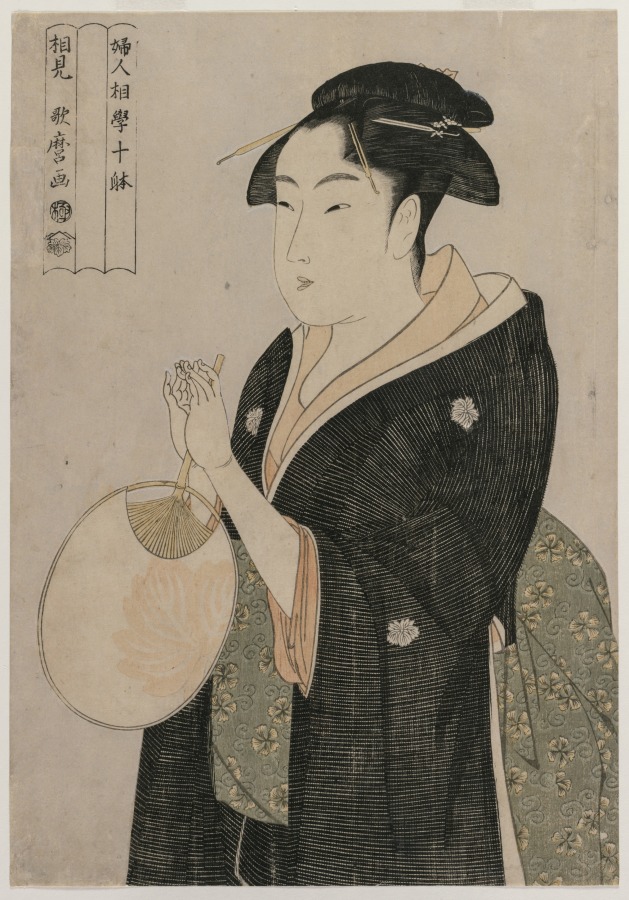
Woman Holding a Fan (from the series Ten Aspects of the Physiognomy of Women)
c. 1793
color woodblock print
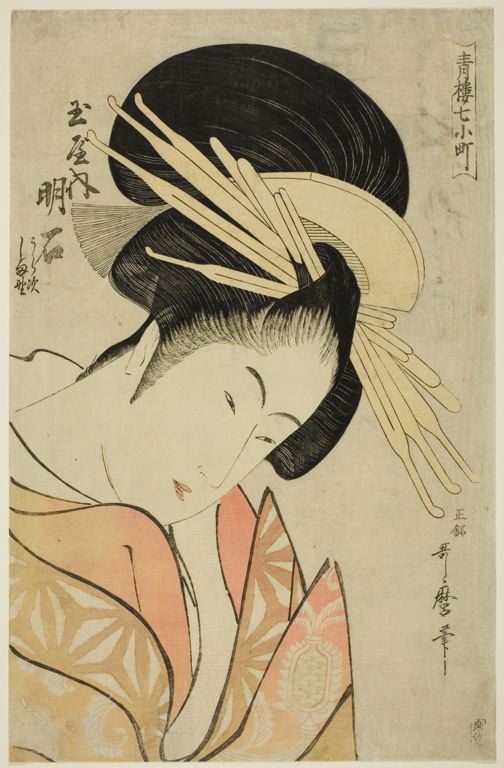
Akashi of the Tamaya, from the series Seven Komachis of Yoshiwara (Seiro nana Komachi) (Tamaya uchi Akashi, Uraji, Shimano)
Woodblock print
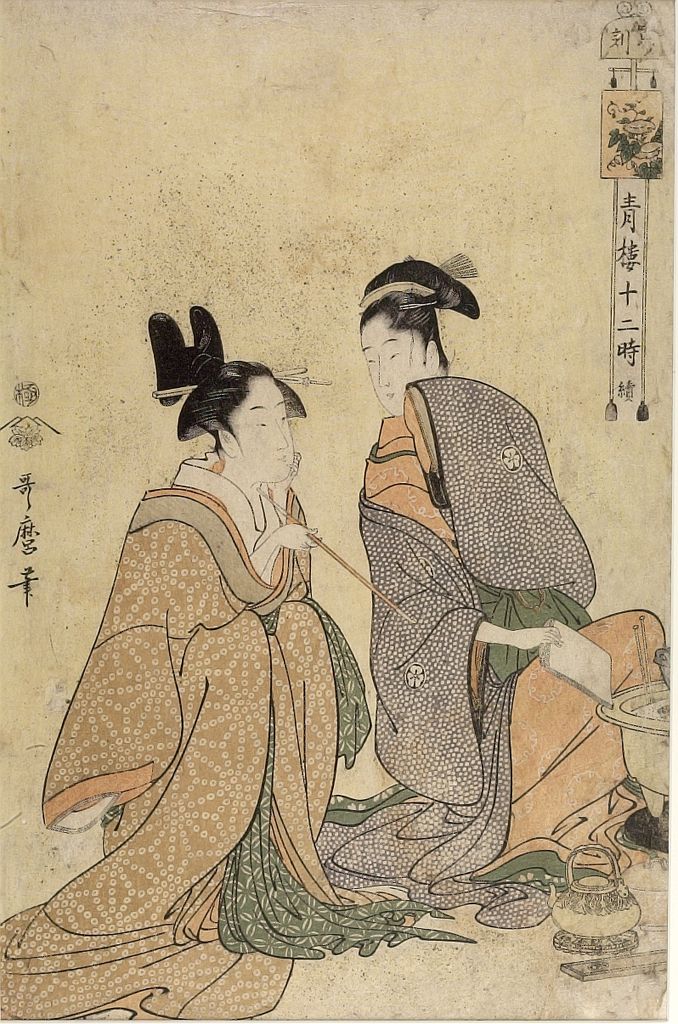
Hour of the Tiger (Tora no koku = 4 AM) from the series Twelve Hours in Yoshiwara (Seirô jûni toki tsuzuki), Late Edo period, circa 1794
Woodblock print
More Rain Prints

Rain Shower at Shо̄no, from the series Fifty-three Stations of the Tо̄kaidо̄ (Tо̄kaidо̄ gojusan tsugi)
1962
Woodblock print, ink and color on paper

Shōno: Driving Rain (Shōno hakuu), from the series Fifty-three Stations of the Tōkaidō (Tōkaidō gojūsan tsugi no uchi), also known as the First Tōkaidō or Great Tōkaidō
c. 1833-36
Woodblock print (nishiki-e); ink and color on paper

Omiya in Rain (Ame no Omiya)
Ame no Omiya
1930
Color woodblock print; oban
Evening Shower at Teradomari (Teradomari no yau), from the series "Souvenirs of Travel, Second Series (Tabi miyage dai nishu)"
Teradomari no yau
1921
Color woodblock print; oban
Frequently Asked Questions
Geisha and Attendant on a Rainy Night was created by Kitagawa Utamaro (喜多川歌麿) in c. 1797.
Geisha and Attendant on a Rainy Night depicts rain.