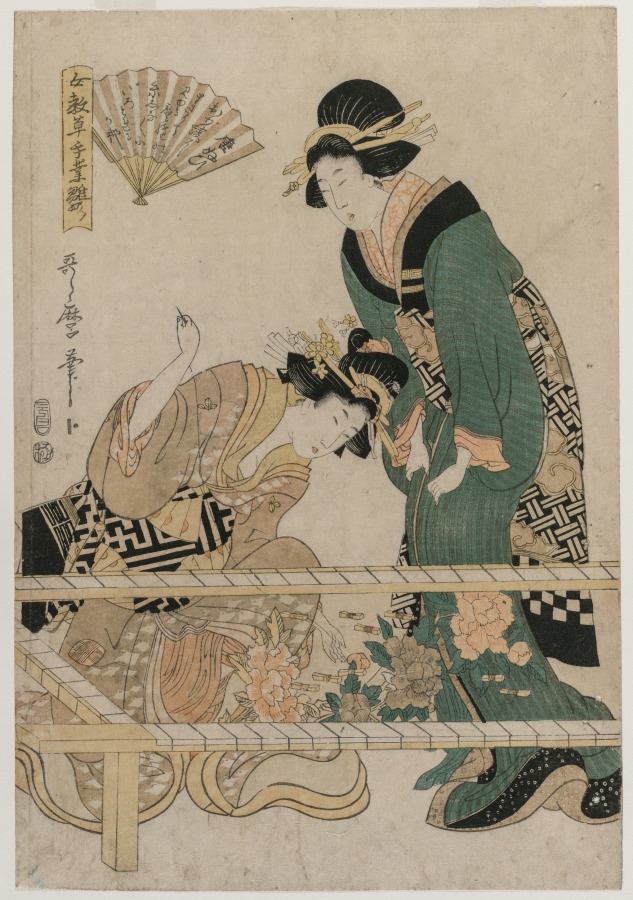
Chinese Embroidery (from the series Instructive Patterns for Women's Handicraft)
- Date:
- 1808
- Medium:
- Color woodblock print
- Source:
- Cleveland Museum of Art
Description
Dated firmly to 1808 and held by the Cleveland Museum of Art (accession 1916.1162), this color woodblock print from the series 'Instructive Patterns for Women's Handicraft' (one of Utamaro II's signature franchises) places the second-generation hand within a didactic-bijin mode that proliferated in the Bunka era. The series uses the conceit of women practicing or being taught domestic and decorative crafts — embroidery, weaving, dyeing — to frame a sequence of fashionable beauties at work, combining moral didacticism (suitable for the post-Kansei publishing climate) with the sensual appeal of the bijin-ga tradition. 'Chinese Embroidery' (karaori) shows a beauty engaged with a piece of imported continental embroidered cloth, a luxury fabric whose patterns were imitated in Edo kimono production. The 1808 date is unambiguously post-Utamaro I, making this print one of the most secure Utamaro II attributions in any Western collection. Cleveland's strong impression preserves the print's clean color separations and the precise carving of the textile patterns.
More Prints by Kitagawa Utamaro II
Frequently Asked Questions
Chinese Embroidery (from the series Instructive Patterns for Women's Handicraft) was created by Kitagawa Utamaro II (二代目喜多川歌麿) in 1808.