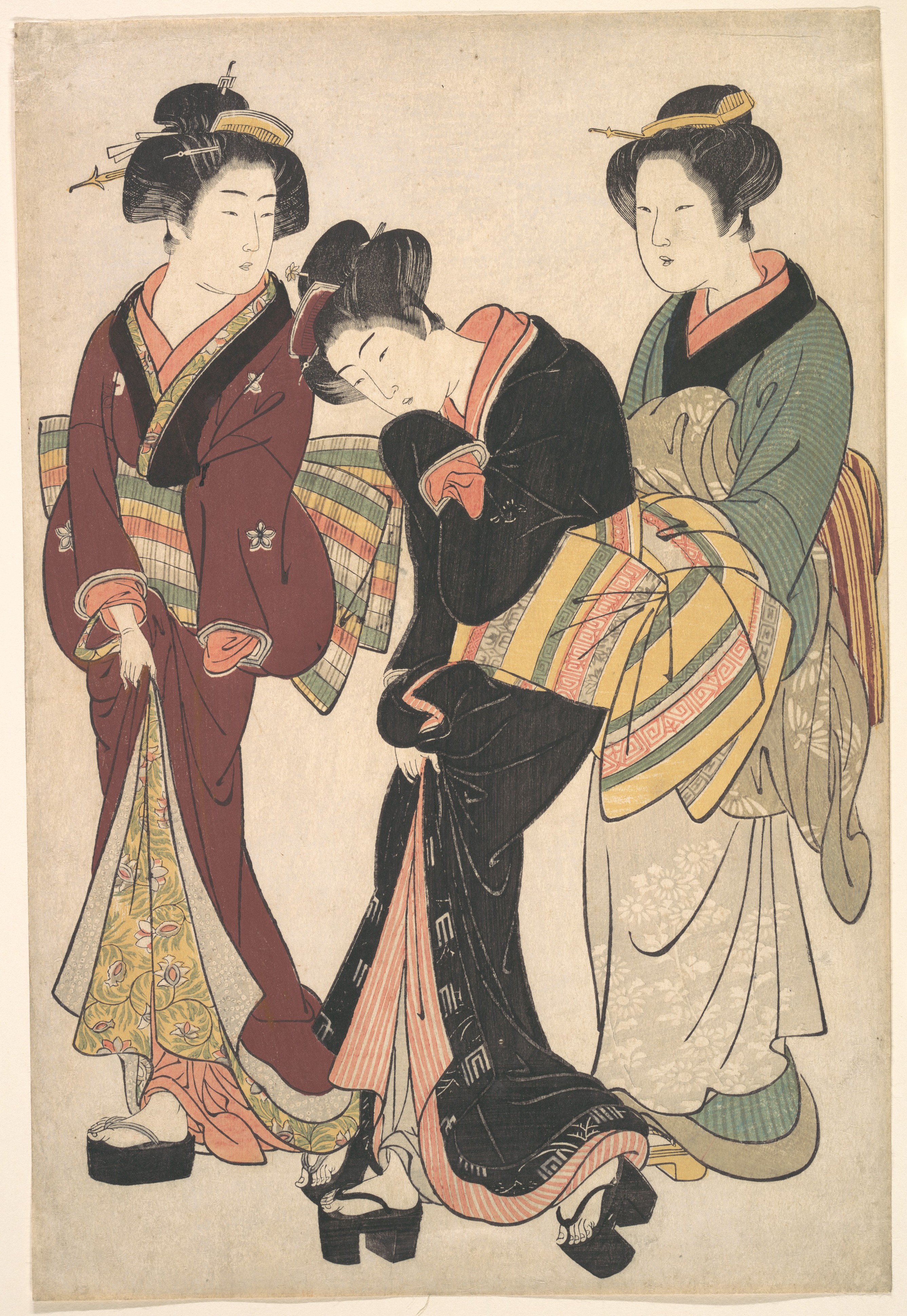
Two Geishas and a Maid
- Date:
- ca. 1790
- Medium:
- Woodblock print; ink and color on paper
- Source:
- Metropolitan Museum of Art
Description
Two Geishas and a Maid, dated to 1780, is a finely observed group bijinga by Kitao Shigemasa in the Metropolitan Museum of Art. The composition presents two adult geishas accompanied by a younger female attendant, perhaps a kamuro or an apprentice, in a scene that suggests the rituals of preparation and accompaniment that surrounded high-ranking entertainers in the Yoshiwara and other licensed districts. Shigemasa orchestrates the three figures so that their robes overlap in a rhythmic interplay of patterns and lines, while their faces, drawn with the calm, slightly idealized features characteristic of his bijinga, communicate the quiet sociability of professional companions. The Metropolitan Museum of Art preserves the print as part of its strong holdings of late eighteenth-century Japanese figural prints. By 1780, Kitao Shigemasa was an established master of Edo ukiyo-e, and his work from this period sits at a pivotal moment between the older idiom of Suzuki Harunobu's diminutive figures and the bolder, more elongated figures that Torii Kiyonaga and Kitagawa Utamaro would soon develop. As founder of the Kitao school, Shigemasa influenced both contemporaries and students, and prints such as Two Geishas and a Maid offered a model for group portraiture that emphasized social context as much as individual beauty. Within his oeuvre this work demonstrates a confident handling of multi-figure compositions, where attention is distributed across the group without privileging any single character at the expense of the others, an approach that helped distinguish the Kitao school's bijinga from the more isolated, iconic figures favored by some competing studios in the same decade.
More Prints by Kitao Shigemasa

Women Holding Boy who is Reaching Out to Young Man Below
c. 1776
Color woodblock print; hashira-e

Priest Saigyo Contemplating Mount Fuji
c. 1770s
Color woodblock print; hashira-e

Autumn Moon over Sumida River (Sumida aki zuki), from the series "Eight Views of the Sumida River (Sumidagawa hakkei)"
early 1760s
Color woodblock print; hosoban, mizu-e

Crossing the Bridge at Sano
c. 1774
Color woodblock print; koban
Frequently Asked Questions
Two Geishas and a Maid was created by Kitao Shigemasa (北尾重政) in ca. 1790.