
Priest Saigyo Contemplating Mount Fuji
- Date:
- c. 1770s
- Medium:
- Color woodblock print; hashira-e
- Source:
- Art Institute of Chicago
Description
Priest Saigyo Contemplating Mount Fuji, dating to the 1770s, is a hashira-e (pillar-print) color woodblock print held by the Art Institute of Chicago. The poet-priest Saigyo (1118-1190) was one of the most beloved figures in Japanese literary tradition - a former samurai who became a Buddhist monk and wandered the country composing waka of profound, melancholy beauty. His most famous poems and the legends gathered around him were repeatedly illustrated, and his contemplation of Mount Fuji on his travels became an iconic emblem of poetic and religious seeking. The hashira-e (pillar-picture) format is a tall, very narrow print designed to be mounted on the wooden pillars of an Edo townhouse interior. The format demanded vertical compositions and disciplined draftsmanship to fit the figure into the slender column; Shigemasa's solution gives Saigyo the foreground in monk's robes with the cone of Fuji rising at the upper margin. The Art Institute of Chicago's holding of this hashira-e is an important record of Shigemasa working in the specialized format that flourished in the late eighteenth century before falling out of fashion.
More Prints by Kitao Shigemasa

Women Holding Boy who is Reaching Out to Young Man Below
c. 1776
Color woodblock print; hashira-e

Autumn Moon over Sumida River (Sumida aki zuki), from the series "Eight Views of the Sumida River (Sumidagawa hakkei)"
early 1760s
Color woodblock print; hosoban, mizu-e

Crossing the Bridge at Sano
c. 1774
Color woodblock print; koban

No. 5: Noda River in Mutsu Province, from the series "Six Jewel Rivers of the Floating World (Ukiyo Mu Tamagawa)"
c. 1769
Color woodblock print; hosoban
More Mount Fuji Prints
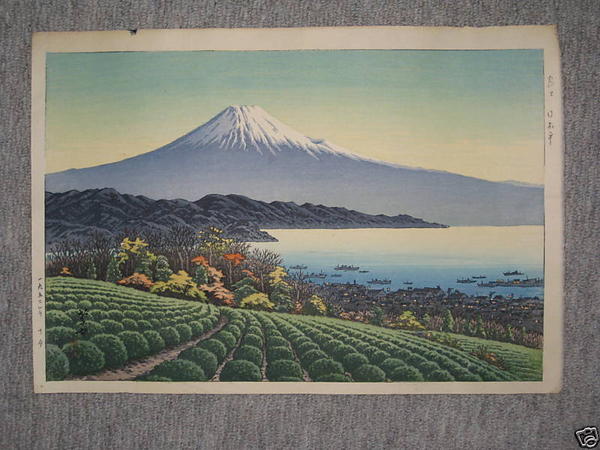
Fuji from tea farm
Woodblock print

Akasaka, Fujikawa, Okazaki, Chiryu, and Narumi, from the series "Famous Places on the Fifty-three Stations of the Tokaido, Five Stations (Tokaido gojusan eki goshuku meisho)"
c. 1830/35
Color woodblock print; oban
![Mount Fuji on a Moonlit Night, Kawai Bridge (Tsukiyo no Fuji [Kawaibashi]), from the series "Selection of Views of the Tokaido (Tokaido fukei senshu)" by Kawase Hasui](https://www.artic.edu/iiif/2/d0960668-1e73-339a-b182-fb995a54bff0/full/843,/0/default.jpg)
Mount Fuji on a Moonlit Night, Kawai Bridge (Tsukiyo no Fuji [Kawaibashi]), from the series "Selection of Views of the Tokaido (Tokaido fukei senshu)"
1947
Color woodblock print; oban

Mt. Fuji in Rain (Ame no Fuji)
n.d.
Color woodblock print
Featured in Collections
Curated cross-cuts that include this print.
Frequently Asked Questions
Priest Saigyo Contemplating Mount Fuji was created by Kitao Shigemasa (北尾重政) in c. 1770s.
Priest Saigyo Contemplating Mount Fuji depicts mount fuji.