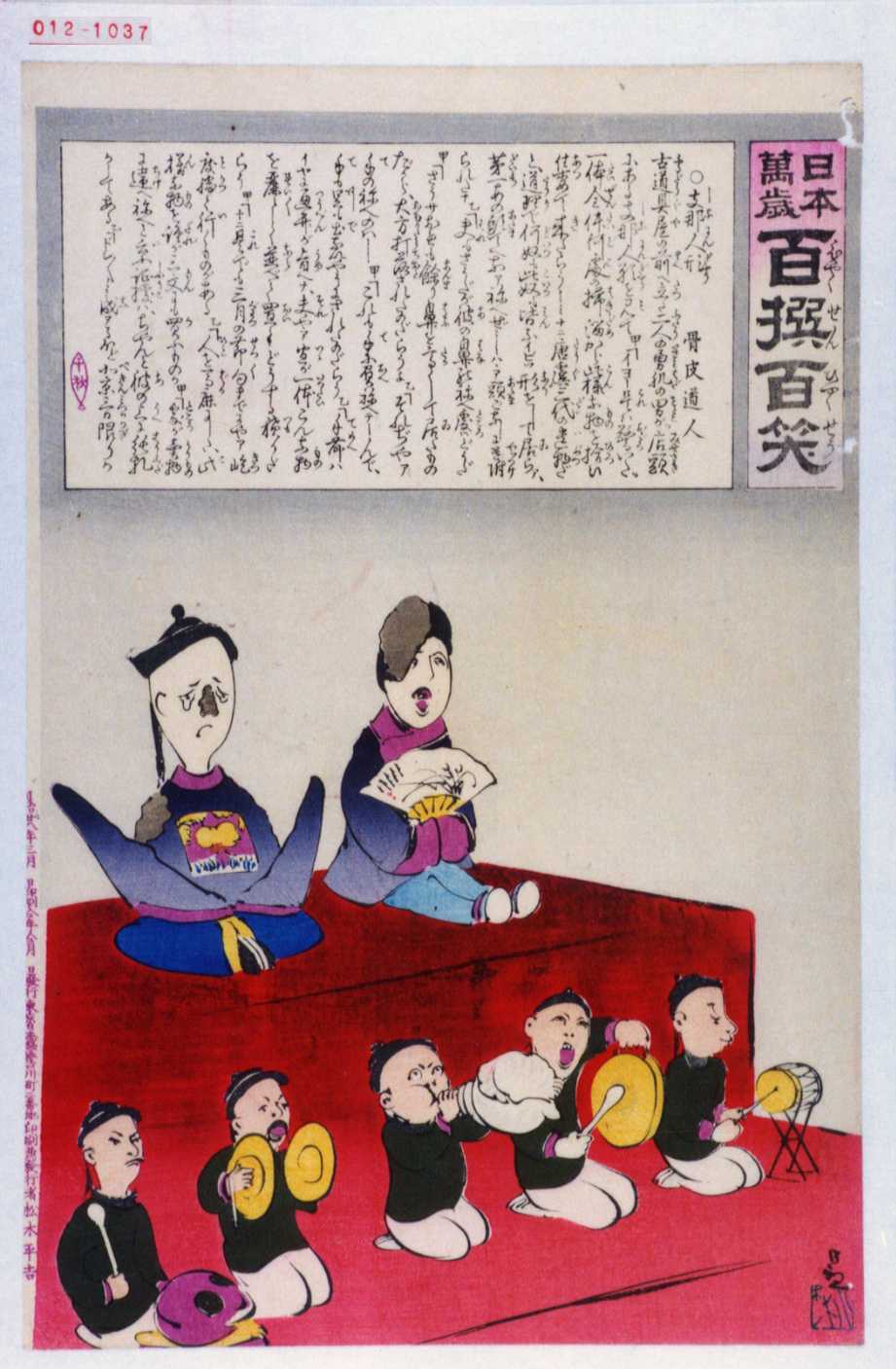
「日本万歳 百撰百笑」「支那人形 骨皮道人」
- Medium:
- Woodblock print
- Source:
- Waseda University
- Image courtesy of
- Waseda University
Description
'Chinese Puppet' or 'Chinese Doll' reduces Chinese soldiers to mechanical figures — lifeless, controlled by external forces, incapable of autonomous action. Published under the pen name Honekawa Dōjin as part of Nippon Banzai: Hyakusen Hyakushō during the First Sino-Japanese War, the print likely depicts a caricatured Chinese military figure with the stiff, jointed limbs of a wooden doll or puppet (人形, ningyō), a visual metaphor for the Qing military's perceived lack of genuine fighting spirit or independent will. The puppet metaphor had particular resonance in Japanese visual culture, where ningyō had long associations with theater, spectacle, and performance without agency. Kiyochika renders the figure with the exaggerated hollowness the metaphor demands — rigid posture, painted-on expression, inert or mechanical movement — using the bold contour lines and flat color areas characteristic of the series' rapid-production caricature format.
More Prints by Kobayashi Kiyochika

Frequently Asked Questions
「日本万歳 百撰百笑」「支那人形 骨皮道人」 was created by Kobayashi Kiyochika (小林清親).