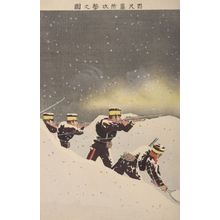
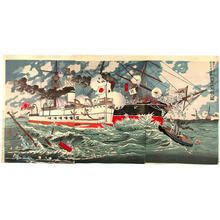
Hyaku-shaku Gaisho kôgeki no zu, Meiji period, dated 1895
- Medium:
- Woodblock print
- Source:
- Harvard Art Museum
- Image courtesy of
- Harvard Art Museum
Description
This 1895 print — the first impression in a series of three versions — depicts an assault on what the title identifies as the Hyaku-shaku Gaisho, a fortified position during the final theater of the First Sino-Japanese War. As the earliest state of the composition, this version likely represents the original block design before any revisions made for subsequent printings. Kiyochika uses the visual grammar of sensō-e assault imagery: charging infantry, cannon or rifle fire rendered through dense smoke effects, and the structural geometry of fortification walls providing compositional anchoring in an otherwise turbulent scene. The title's reference to a hundred-shaku height suggests the print depicts a vertical assault on an elevated defensive work — a type of military action that would emphasize the physical effort of climbing under fire and translate well into woodblock's capacity for dramatic bodily posture. The 1895 date places the print in the war's closing months, as Japanese forces had achieved control over the Korean peninsula and were pressing into Chinese-held Manchuria and Shandong. Production continued until the Treaty of Shimonoseki in April 1895.
More Prints by Kobayashi Kiyochika
Frequently Asked Questions
Hyaku-shaku Gaisho kôgeki no zu, Meiji period, dated 1895 was created by Kobayashi Kiyochika (小林清親).