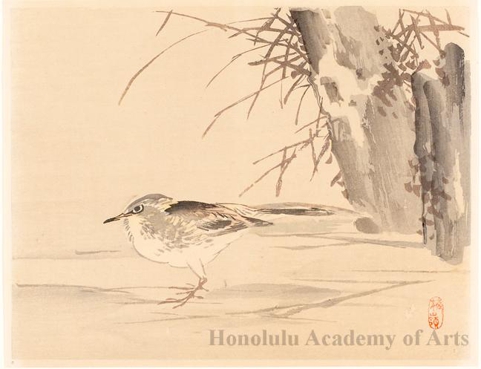
Birds and Reeds
by Kōno Bairei
- Medium:
- Woodblock print
- Source:
- Honolulu Museum of Art
Description
Birds and Reeds, dated 1897 and held by the Honolulu Museum of Art, is a posthumous-period kachō-ga in which Kono Bairei's signature pairing of small birds with water-edge vegetation continues to circulate two years after his death in 1895. The pairing of birds with reeds had a long pedigree in East Asian kachō-ga, with the Chinese ashi ni yamashigi (reed-and-snipe) tradition transmitted into Japan through both Kano and Maruyama-Shijo channels and becoming a recurring autumn subject for late Edo and Meiji painters. Bairei's treatment uses the brushed ink line he inherited from his teachers Nakajima Raisho and Shiokawa Bunrin in the Maruyama-Shijo lineage of Okyo and Goshun, articulating the reed stalks in parallel vertical strokes and giving the birds — typically small water-loving species such as sparrows, finches, or buntings — observed feather articulation and alert posture. The composition uses high horizon and minimal background, the reeds rising through the sheet and the birds placed as small animating presences either perched on or alighting among the stems, with soft graded color and restrained registration in the manner of a hanging scroll quoted on paper. The 1897 date on the Honolulu sheet suggests one of the posthumous editions issued from Bairei's original blocks or designs by Kyoto publishers continuing to draw on his accumulated visual archive. The Honolulu Museum of Art catalogues the print (http://www.honolulumuseum.org/art/5806) within its substantial holdings of Meiji and Taishō prints, where Birds and Reeds functions as a representative single-sheet example of Bairei's mature Kyoto Shijo school kachō-ga manner. It is a clear instance of Kono Bairei's Meiji nihonga vocabulary continuing to circulate in print form after the artist's death.
More Prints by Kōno Bairei


Frequently Asked Questions
Birds and Reeds was created by Kōno Bairei (幸野楳嶺).