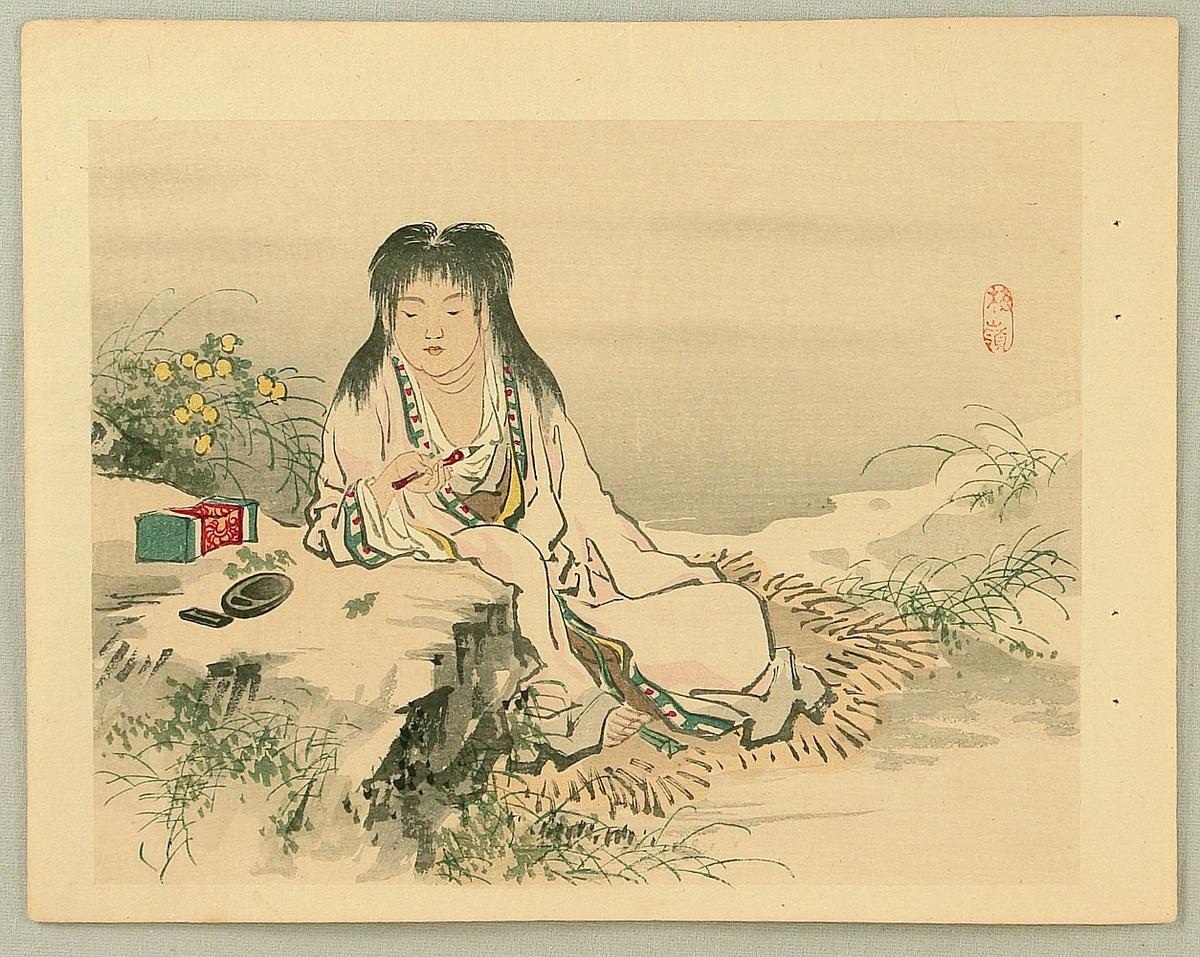
Chrysanthemum Boy
by Kōno Bairei
- Medium:
- Woodblock print
- Source:
- Japanese Art Open Database
Description
Chrysanthemum Boy, documented in the Japanese Art Open Database, is a figural composition in which Kono Bairei depicts a young boy with chrysanthemums, a subject that draws together two recurring strands of Kyoto Shijo school iconography: the genre subject of the child in seasonal play and the canonical autumn flower of the Japanese painting calendar. The chrysanthemum (kiku) carries especially dense associations in Japanese tradition — through its imperial-crest status, its Daoist longevity symbolism inherited from Chinese sources, and the Chrysanthemum Festival (Chōyō no sekku, the ninth day of the ninth month) on which chrysanthemum-themed designs were exchanged and displayed. The chrysanthemum-boy specifically may reference the Chinese legend of Kiku-jidō, the chrysanthemum lad who attained immortality through chrysanthemum-scented dew, a story dramatized in Noh as Kikujidō and a recurring subject in Japanese painting from the Muromachi period onward. Bairei renders the figure with the brushed ink line of his Kyoto Shijo school training under Nakajima Raisho and Shiokawa Bunrin, the robes falling in observed folds and the chrysanthemum blooms given the spiky-petal massing and graded color characteristic of his mature floral manner. The composition uses high horizon and minimal background, with the figure and his flowers placed in the manner of a hanging scroll quoted on paper. The Japanese Art Open Database preserves the sheet (http://www.jaodb.com/db/ItemDetail.asp?item=42792) among its records of nineteenth- and twentieth-century Japanese prints, where Chrysanthemum Boy functions as a clear example of Kono Bairei extending his Meiji nihonga kachō-ga vocabulary into a Kyoto Shijo school figural subject rooted in classical literary and legendary tradition.
More Prints by Kōno Bairei


Frequently Asked Questions
Chrysanthemum Boy was created by Kōno Bairei (幸野楳嶺).