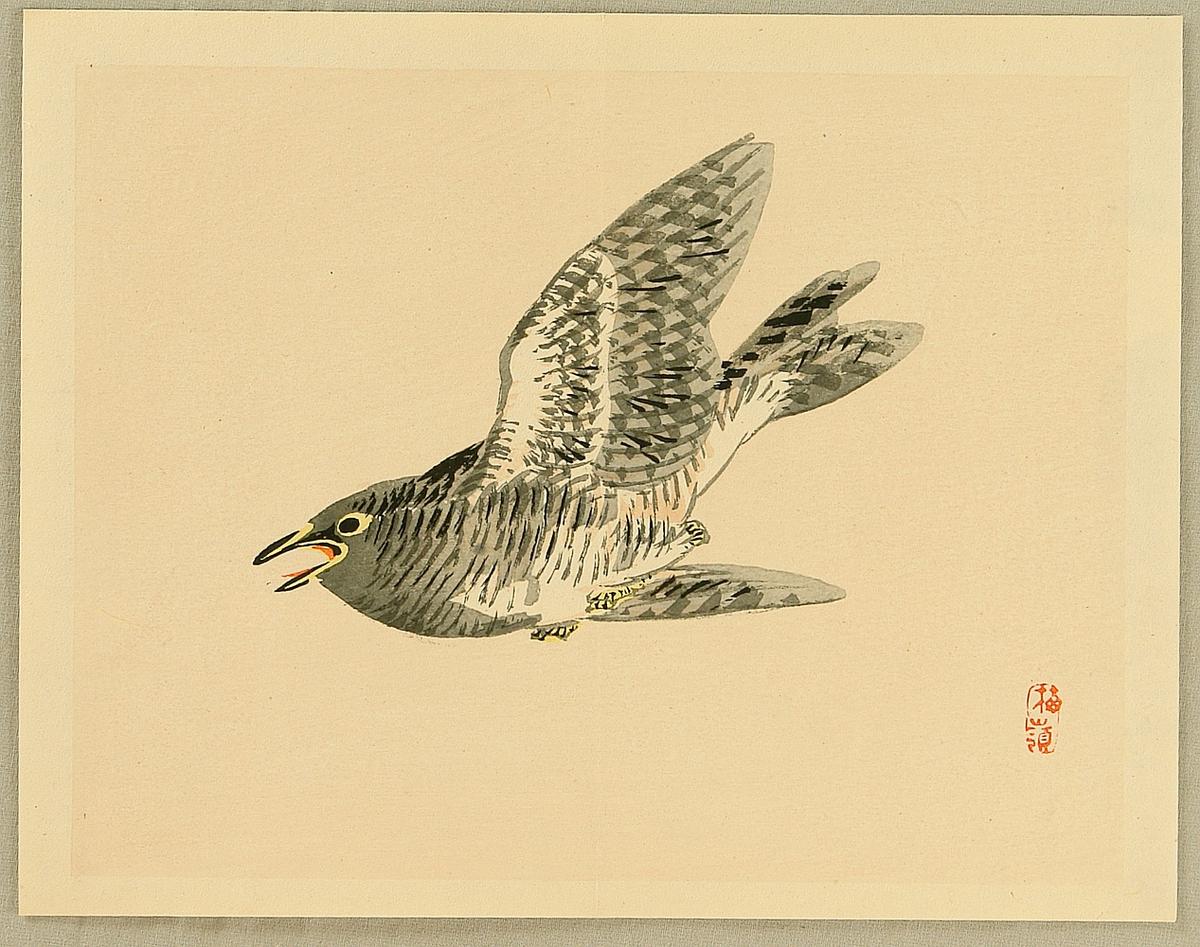
Cuckoo in Flight
by Kōno Bairei
- Medium:
- Woodblock print
- Source:
- Japanese Art Open Database
Description
Cuckoo in Flight, documented in the Japanese Art Open Database, is a kachō-ga composition in which Kono Bairei depicts the hototogisu — the Japanese lesser cuckoo — caught in mid-flight against an indicated sky. The hototogisu carried perhaps the most charged literary associations of any bird in the Japanese poetic tradition, appearing across the Manyōshū, Heian classical poetry, and the haikai tradition of Bashō and his successors as the canonical voice of early summer, of nocturnal longing, and of the threshold between seasons. Its distinctive call, traditionally rendered phonetically in Japanese verse, made it a bird more often heard than seen, which gave its visual depiction a special status in Kyoto Shijo school painting: the artist had to convey the species through observed flight and silhouette rather than through the perched, leaf-side pose that defines most kachō-ga. Bairei renders the bird with the brushed ink line he inherited from his teachers Nakajima Raisho and Shiokawa Bunrin in the Maruyama-Shijo lineage, the wings spread and the body angled in the characteristic forward dart of a hototogisu mid-passage, with the barred underside and small head articulated in fine line. The composition uses minimal background, the sky indicated by graded color wash or unprinted ground in the manner of a hanging scroll quoted on paper. The Japanese Art Open Database preserves the sheet (http://www.jaodb.com/db/ItemDetail.asp?item=43192) among its records of nineteenth- and twentieth-century Japanese prints, where Cuckoo in Flight functions as a representative single-sheet example of Bairei's Kyoto Shijo school bird-in-flight vocabulary outside his more famous album publications. It is a clear instance of Kono Bairei's Meiji nihonga observational practice applied to a literarily charged species.
More Prints by Kōno Bairei


Frequently Asked Questions
Cuckoo in Flight was created by Kōno Bairei (幸野楳嶺).