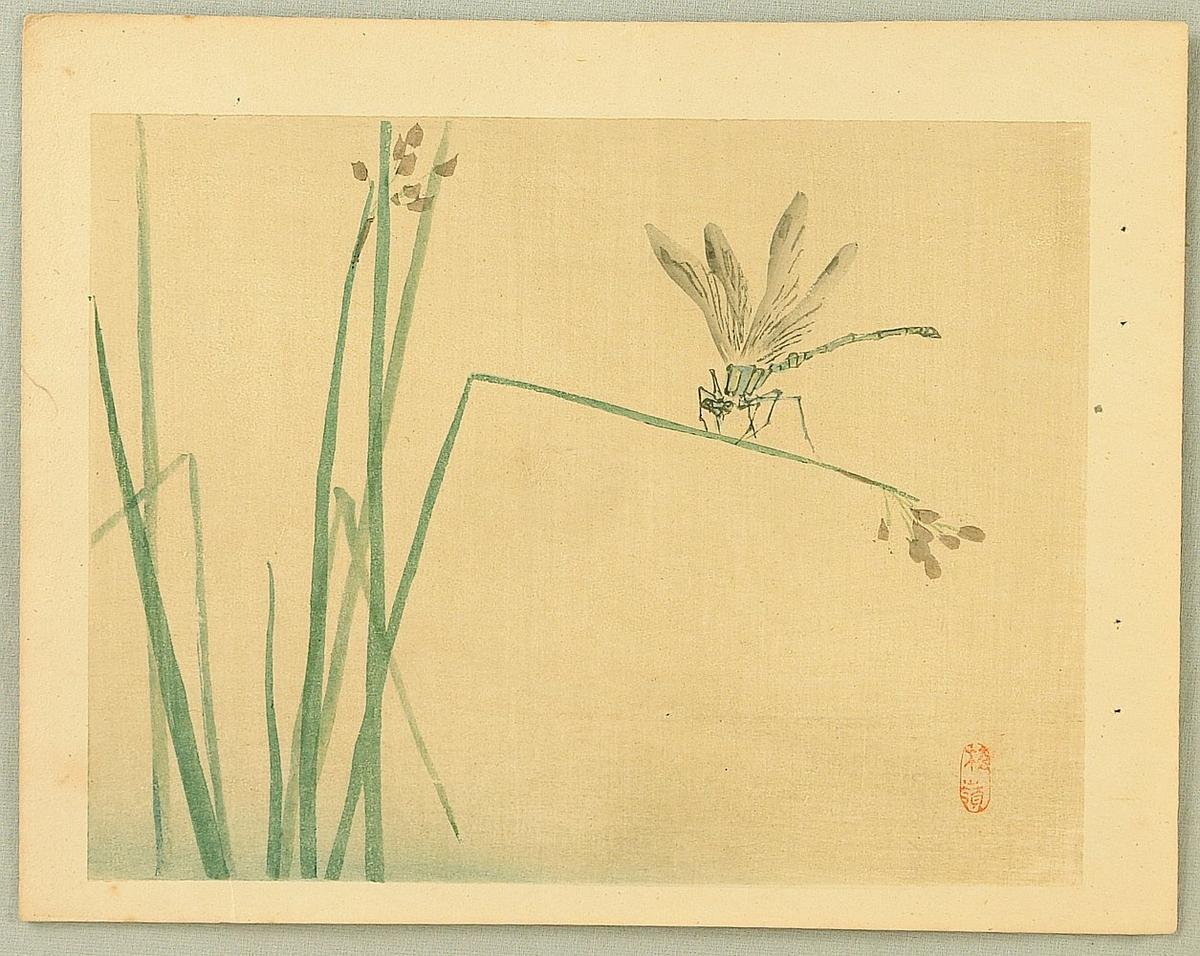
Dragonfly
by Kōno Bairei
- Medium:
- Woodblock print
- Source:
- Japanese Art Open Database
Description
Dragonfly, documented in the Japanese Art Open Database, is a small insect study in which Kono Bairei extends his Kyoto Shijo school observational discipline from birds and flowers to the late-summer fauna of the Japanese countryside. The dragonfly (tonbo) had carried strong associations in Japanese painting since at least the Heian period, when its name was sometimes given to the country itself (Akitsushima, the dragonfly islands), and through the Edo and Meiji periods it remained a canonical symbol of late summer, harvest readiness, and martial perseverance — the latter through its forward-flying habit, which became a samurai emblem of decisive advance. Bairei renders the insect with the brushed ink line he inherited from his teachers Nakajima Raisho and Shiokawa Bunrin in the Maruyama-Shijo lineage, the four-wing veining articulated in fine line and the segmented body given soft graded color in the woodblock medium. The choice of subject reflects the Shijo school's long-standing interest in extending kachō-ga beyond canonical bird-and-flower pairings to the full range of seasonal life — insects, fish, shellfish, small mammals — that Maruyama Okyo and Matsumura Goshun had treated as legitimate painting subjects from the late eighteenth century. The composition uses high horizon and minimal background, the insect occupying only a small portion of the sheet against open ground in the manner of a hanging scroll quoted on paper. The Japanese Art Open Database preserves the sheet (http://www.jaodb.com/db/ItemDetail.asp?item=42775) among its records of nineteenth- and twentieth-century Japanese prints, where Dragonfly functions as a clear example of Kono Bairei applying Kyoto Shijo school observational rigor to a small-scale insect subject in Meiji nihonga print form.
More Prints by Kōno Bairei


Frequently Asked Questions
Dragonfly was created by Kōno Bairei (幸野楳嶺).