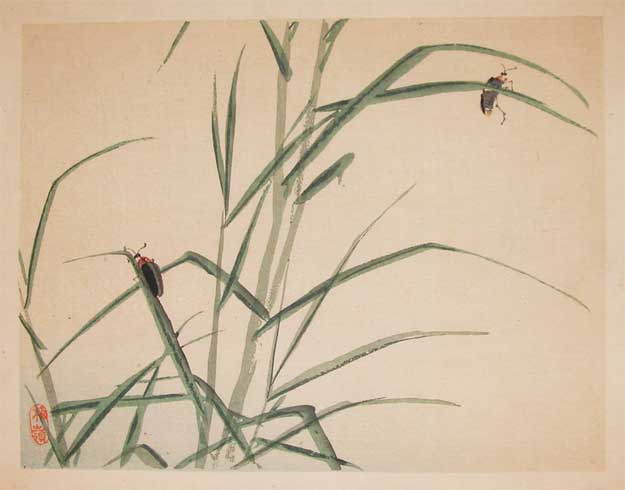
Fireflies
by Kōno Bairei
- Medium:
- Woodblock print
- Source:
- Japan Collection
Description
Fireflies, documented in the Japan Collection dealer archive, is one of Kono Bairei's most atmospheric kachō-ga compositions, depicting the small bioluminescent insects (hotaru) for which early summer evenings along the rivers and rice paddies of Kyoto and Uji were celebrated in classical Japanese poetry. The firefly had carried a long literary pedigree in Japan, appearing in the Manyōshū and across the Heian classical canon as an image of momentary illumination, transient beauty, and the souls of the dead returning briefly to earth — associations that continued through the Edo period and into the Meiji-era nihonga vocabulary that Bairei did so much to define. The composition typically depicts a few fireflies suspended against an indicated water-edge setting of reeds or grasses, the insects rendered as small bright marks against a softly toned ground that evokes summer dusk. Bairei's brushed ink line, inherited from his teachers Nakajima Raisho and Shiokawa Bunrin in the Maruyama-Shijo lineage, articulates the reed stalks and the insects' small wing-and-body forms with the observational care the Kyoto Shijo school demanded. The woodblock medium translates those brush effects into restrained color gradation and careful registration, the firefly bodies often touched with subtle metallic pigment to suggest their glow. The Japan Collection archive preserves the sheet (http://www.japancollection.com/japanese-prints-uview/print.php?pid=8865) among its records of late-Meiji and Taishō prints, where Fireflies functions as a representative example of Bairei's seasonal atmospheric range. It is a clear instance of Kono Bairei translating the Kyoto Shijo school's evening-light painting vocabulary into Meiji nihonga print form.
More Prints by Kōno Bairei


Frequently Asked Questions
Fireflies was created by Kōno Bairei (幸野楳嶺).