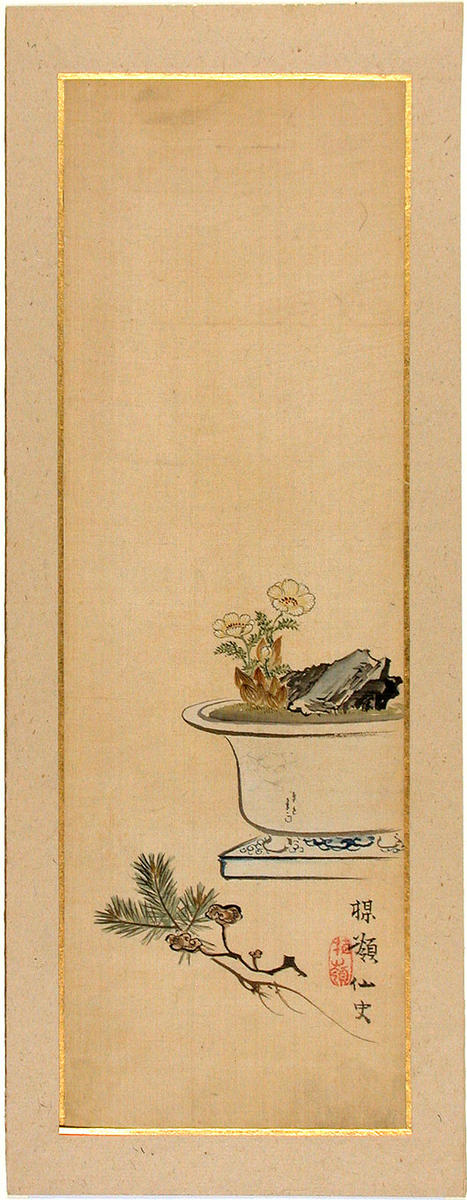
Flower Pot
by Kōno Bairei
- Medium:
- Painting on silk
- Source:
- Japanese Art Open Database
Description
Flower Pot, documented in the Japanese Art Open Database, is a small still-life composition in which Kono Bairei brings his Kyoto Shijo school observational discipline to the quiet subject of a potted plant — a domestic arrangement of the kind that filled the verandas and tea-room thresholds of Kyoto townhouses through the seasons. The print depicts a single container, likely ceramic or glazed earthenware in the manner of Kyoto's domestic pottery tradition, holding a seasonal plant rendered in the brushed ink line and soft graded color characteristic of Bairei's mature Meiji nihonga style. As the leading pupil of Nakajima Raisho and Shiokawa Bunrin in the Maruyama-Shijo lineage of Okyo and Goshun, Bairei carried the school's emphasis on life observation into compositions like this one, where the still-life subject sits at the threshold between bird-and-flower painting and pure botanical study. The choice of a potted plant rather than a flowering branch in nature signals the domestic register of the design — a plant tended by human hand rather than encountered in the wild — placing the print within a longer Kyoto Shijo school tradition of treating the everyday garden as legitimate painting subject. The composition uses high horizon and minimal background, the pot occupying a single calibrated zone of the sheet in the manner of a hanging scroll quoted on paper. The Japanese Art Open Database preserves the sheet (http://www.jaodb.com/db/ItemDetail.asp?item=44108) among its records of nineteenth- and twentieth-century Japanese prints, where Flower Pot functions as a representative example of Bairei's range within Meiji nihonga still-life practice. It is a clear instance of Kono Bairei applying Kyoto Shijo school observational rigor to a quiet domestic subject.
More Prints by Kōno Bairei


Frequently Asked Questions
Flower Pot was created by Kōno Bairei (幸野楳嶺).