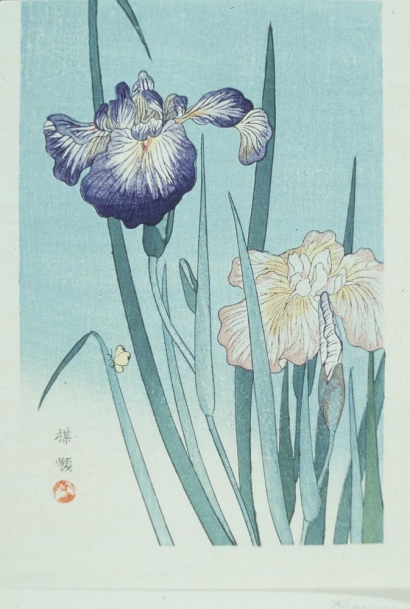
Iris
by Kōno Bairei
- Medium:
- Woodblock print
- Source:
- Art Gallery of Greater Victoria
Description
Iris, held by the Art Gallery of Greater Victoria, is a single-subject floral study in which Kono Bairei applies his Kyoto Shijo school observational discipline to one of the most charged seasonal flowers of the Japanese painting calendar. The iris (kakitsubata or hanashōbu, depending on species) had carried a long literary and visual pedigree in Japan since at least the Heian period, when the Ise monogatari's kakitsubata episode at Yatsuhashi fixed the flower as an emblem of journey and longing, and through the Edo and Meiji periods it remained a canonical early-summer subject in both painting and printmaking — most famously in the screens of Ogata Korin. Bairei renders the iris with the brushed ink line he inherited from his teachers Nakajima Raisho and Shiokawa Bunrin in the Maruyama-Shijo lineage, the distinctive sword-shaped leaves rising in calibrated parallel and the three-petal flower form opening in graded color above. The composition uses high horizon and minimal background, the iris occupying the sheet against open ground in the manner of a hanging scroll quoted on paper, with the soft purple-and-yellow palette characteristic of Bairei's mature Meiji nihonga floral practice. The Art Gallery of Greater Victoria catalogues the sheet (http://aggv.ca/artwork/bairei-iris) within its holdings of Japanese prints, where Iris functions as a representative single-sheet example of Bairei's Kyoto Shijo school floral vocabulary outside his more famous illustrated albums. It is a clear instance of Kono Bairei translating the Maruyama-Shijo iris-painting tradition into woodblock form for the late-nineteenth-century Meiji nihonga audience.
More Prints by Kōno Bairei


Frequently Asked Questions
Iris was created by Kōno Bairei (幸野楳嶺).