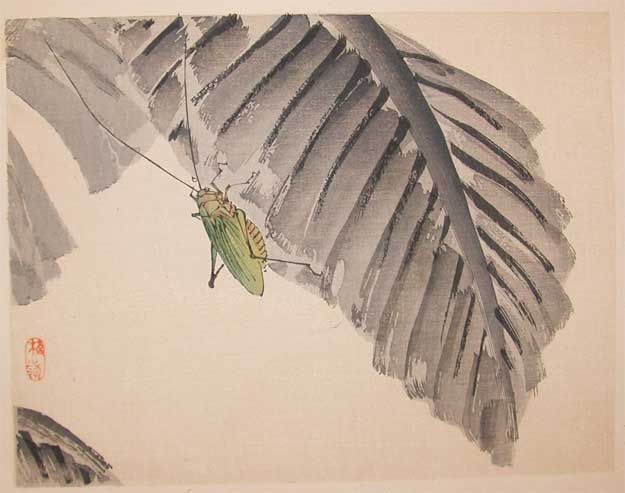
Katydid on Banana Leaf
by Kōno Bairei
- Medium:
- Woodblock print
- Source:
- Japan Collection
Description
Katydid on Banana Leaf, undated but produced by Kōno Bairei (1844–1895) within the broader career of his Kyoto-based kachō-e practice, exemplifies the close attention to small natural subjects that defined his contribution to late-Meiji bird-and-flower printmaking. Bairei trained in the Maruyama-Shijō tradition under Nakajima Raishō and Shiokawa Bunrin, inheriting from them — and ultimately from Maruyama Ōkyo and Goshun — a commitment to direct observation of nature combined with the calligraphic economy of brushwork that had defined Kyoto painting since the late eighteenth century. The katydid (kirigirisu) is a recurring summer-evening subject in classical Japanese painting and poetry, often appearing in haikai compilations as a sign of seasonal transition. In Bairei's hands, the insect is rendered with entomological precision against the broad simple sweep of a single banana leaf, the entire composition organized around the play between the katydid's articulated body and the leaf's continuous arc. The result is the kind of restrained kachō-e composition that came to define Bairei's albums — most famously Bairei Kacho Gafu (Bairei's Bird and Flower Album), where each opening pairs a single creature with a single botanical element in a meditation on seasonality and observation. Japan Collection preserves this impression in its open-access reference catalogue (http://www.japancollection.com/japanese-prints-uview/print.php?pid=8867) and groups it within Bairei's broader output of single-spread kachō-e that influenced not only his many Kyoto students — Imao Keinen, Takeuchi Seihō, Kikuchi Hōbun — but the wider late-Meiji print revival's understanding of how Maruyama-Shijō naturalism could be translated into the mass-reproduced woodblock medium.
More Prints by Kōno Bairei


Frequently Asked Questions
Katydid on Banana Leaf was created by Kōno Bairei (幸野楳嶺).