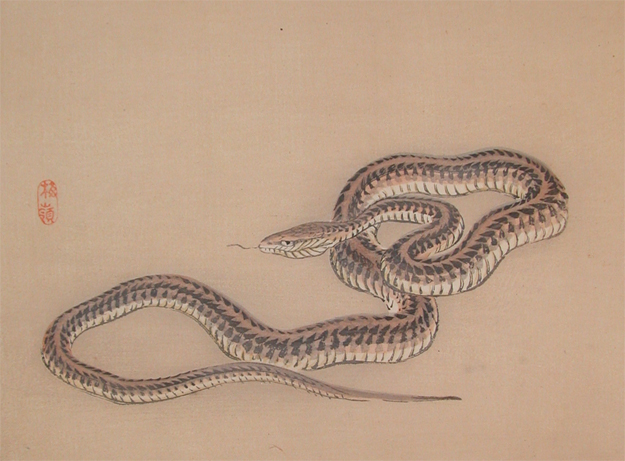
Snake
by Kōno Bairei
- Medium:
- Woodblock print
- Source:
- Japan Collection
Description
Snake, dated 1890 and documented in the Japan Collection dealer archive, is a single-subject study in which Kono Bairei brings his Kyoto Shijo school observational discipline to one of the twelve zodiac animals and a recurring motif in Japanese painting iconography. The snake (hebi or mi in zodiac usage) carries dense associations in Japanese tradition: as one of the twelve calendrical animals it marks Year of the Snake designs; as a messenger of the goddess Benzaiten it appears in religious art associated with water deities and prosperity; and as a presence in the natural world it had long been a subject of careful observation in the Maruyama-Shijo painting tradition, where Maruyama Okyo and his successors prized the close study of scale patterning, body articulation, and the snake's distinctive coiling and undulating postures. Bairei renders the snake with the brushed ink line he inherited from his teachers Nakajima Raisho and Shiokawa Bunrin, the scale pattern indicated through fine repeated marks and the body's curve drawn with the controlled brush gesture characteristic of Kyoto Shijo school work. The composition uses high horizon and minimal background, the snake occupying the sheet against open ground or a single brushed indication of rock or grass in the manner of a hanging scroll quoted on paper. The Japan Collection archive preserves the sheet (http://www.japancollection.com/japanese-prints-uview/print.php?pid=8569) among its records of late-Meiji and Taishō prints, where Snake functions as a representative example of Bairei's mature kachō-ga vocabulary applied beyond bird and flower to broader zodiac and seasonal subjects. It is a clear instance of Kono Bairei's Meiji nihonga observational practice in single-sheet form.
More Prints by Kōno Bairei


Frequently Asked Questions
Snake was created by Kōno Bairei (幸野楳嶺).