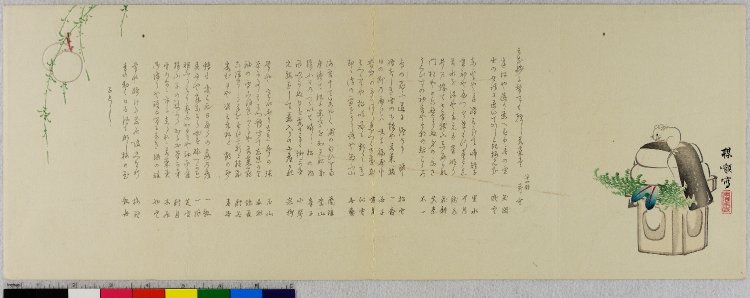
White Mouse on Mochi (surimono)
by Kōno Bairei
- Medium:
- Woodblock print (surimono)
- Source:
- British Museum
Description
White Mouse on Mochi (surimono), held by the British Museum, is a small privately commissioned New Year print in which Kono Bairei brings his Kyoto Shijo school kachō-ga sensibility to one of the most auspicious motif pairings in the Japanese seasonal calendar. The white mouse — a rare and prized variant of the common rat (nezumi) — carries especially strong auspicious meaning through its association with Daikokuten, the household god of prosperity, whose iconography frequently includes mice as attendants. Paired with the round kagamimochi rice cakes set out at New Year as offering and display, the design compresses zodiac, harvest, and household-deity meaning into a single composition. As a surimono — privately commissioned, printed in limited numbers for poetry circles or personal exchange — the design would originally have been paired with kyōka verse and printed with the lavish techniques associated with the format: thicker washi, metallic and embossed pigments, and careful registration. Bairei's brushed ink line, observed in the mouse's whiskers, ear-folds, and paw positioning, reflects the Kyoto Shijo school discipline he inherited from his teachers Nakajima Raisho and Shiokawa Bunrin and ultimately from the Maruyama-Shijo lineage of Okyo and Goshun. The British Museum catalogues the sheet (https://www.britishmuseum.org/collection/object/A_1980-1022-0-769) within its substantial holdings of Japanese surimono, where Bairei's contribution sits alongside the better-known Edo surimono designers of earlier generations and demonstrates how the Kyoto Shijo school adapted the format for late-Meiji private circulation. It is a clear example of Kono Bairei's range outside the printed-book program of the hyakuchō and kachō gafu albums.
More Prints by Kōno Bairei


Frequently Asked Questions
White Mouse on Mochi (surimono) was created by Kōno Bairei (幸野楳嶺).