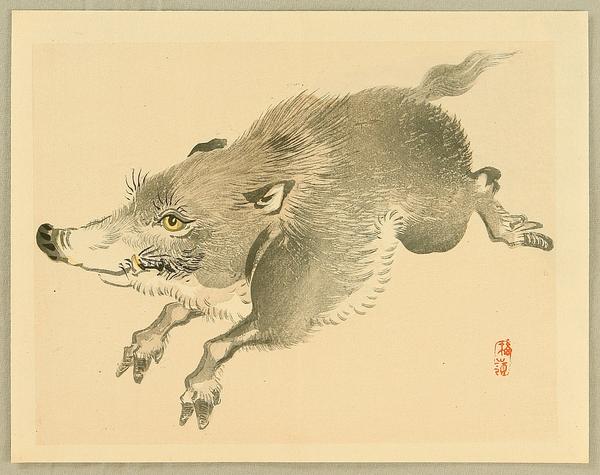
Wild Boar
by Kōno Bairei
- Medium:
- Woodblock print
- Source:
- Japanese Art Open Database
Description
Wild Boar, documented in the Japanese Art Open Database, is an animal study in which Kono Bairei applies his Kyoto Shijo school observational discipline to the inoshishi, the wild boar of the Japanese mountains and one of the twelve zodiac animals. The wild boar carried dense associations in Japanese tradition: as the twelfth zodiac animal (i, the boar) it marked Year of the Boar designs; through the Heian and Kamakura periods it appeared in courtly hunting iconography; and in the Maruyama-Shijo painting tradition specifically it became a canonical subject for life-sketching, with both Maruyama Okyo and Mori Sosen producing celebrated boar studies that gave the animal's bristled coat, low-slung body, and forward-thrusting posture careful observational treatment. Bairei's print extends that lineage, rendering the boar with the brushed ink line he inherited from his teachers Nakajima Raisho and Shiokawa Bunrin and using soft graded color in the woodblock medium to suggest the dense brown-and-black coat. The composition uses high horizon and minimal background, with a few brushed indications of grass, rock, or autumn foliage placing the animal in a sparse mountain setting in the manner of a hanging scroll quoted on paper. The Japanese Art Open Database preserves the sheet (http://www.jaodb.com/db/ItemDetail.asp?item=43191) among its records of nineteenth- and twentieth-century Japanese prints, where Wild Boar functions as a representative single-sheet example of Bairei's range beyond bird-and-flower pairings into the broader Kyoto Shijo school animal-study tradition. It is a clear instance of Kono Bairei applying Maruyama-Shijo observational rigor to a charged zodiac and mountain-fauna subject in Meiji nihonga print form.
More Prints by Kōno Bairei


Frequently Asked Questions
Wild Boar was created by Kōno Bairei (幸野楳嶺).