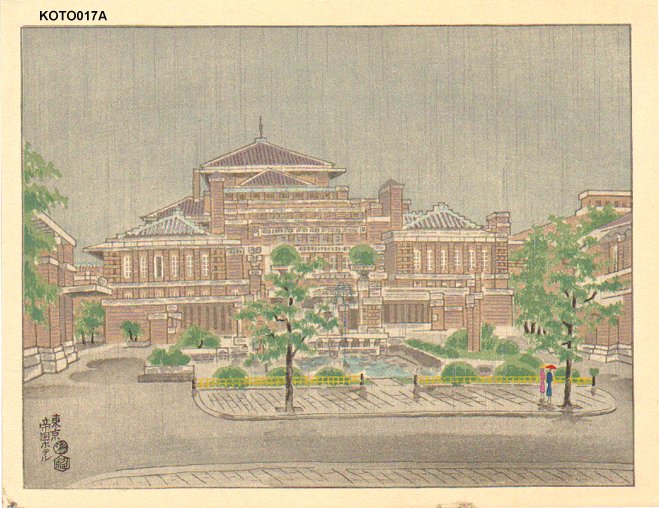
Tokyo Imperial Hotel
- Medium:
- Woodblock print
- Source:
- Watanabe Print
- Image courtesy of
- Watanabe Print
Description
Frank Lloyd Wright's Imperial Hotel in Tokyo's Hibiya district, completed in 1923 and demolished in 1968, was one of the most celebrated Western-style buildings in Japan. Its low horizontal profile, Prairie-influenced Oya stone ornament, and distinctive floating foundation—which famously withstood the Great Kantō Earthquake of September 1923—made it an enduring landmark. This subject represents a marked departure from Kotozuka's habitual repertoire of temples, shrine precincts, and traditional gardens. The composition likely documents the hotel's symmetrical main facade with its alternating horizontal stone bands and central entrance block. Kotozuka's application of woodblock technique to a subject defined by rectilinear Western modernism would constitute a deliberate exercise in translating Prairie-style architecture—built around long horizontal lines and geometric ornamental relief—into a medium historically shaped by Japanese spatial conventions and organic subject matter. The print's existence among Kotozuka's output suggests he was documenting Japan's built environment broadly, not exclusively its traditional heritage.
More Prints by Kotozuka Eiichi
Featured in Collections
Curated cross-cuts that include this print.
Frequently Asked Questions
Tokyo Imperial Hotel was created by Kotozuka Eiichi (琴塚英一).