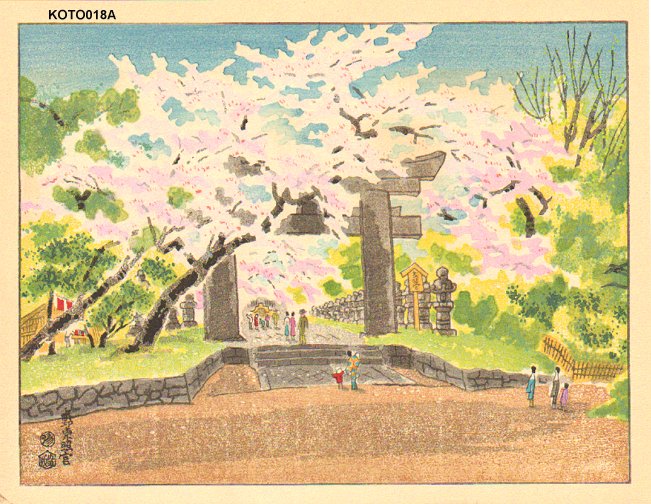
Ueno Tosho-gu (Tokyo)
- Medium:
- Woodblock print
- Source:
- Watanabe Print
- Image courtesy of
- Watanabe Print
Description
The Toshogu shrine at Ueno, in Tokyo's Taito ward, is one of the few surviving Edo-period shrine complexes in the city. Founded in 1627 and expanded in 1651 to enshrine Tokugawa Ieyasu, it retains its original lantern-lined stone approach, Chinese-style karamon gate, and elaborate haiden oratory—structures that survived the fires and wartime destruction that eliminated most of historical Tokyo. Kotozuka's print likely emphasizes the long avenue of approximately two hundred stone lanterns donated by daimyo from across Japan, framing the approach to the main shrine buildings as a receding architectural corridor. The karamon gate's polychrome carvings—phoenixes, Chinese lions, and floral motifs picked out in lacquer and gilt—present material comparable to his Nikkō Yomeimon subjects. This print extends Kotozuka's Tokyo documentation beyond the Imperial Hotel to include surviving traditional architecture, connecting his broader project of recording Japan's historic built environment across its two major cities.
More Prints by Kotozuka Eiichi
Featured in Collections
Curated cross-cuts that include this print.
Frequently Asked Questions
Ueno Tosho-gu (Tokyo) was created by Kotozuka Eiichi (琴塚英一).