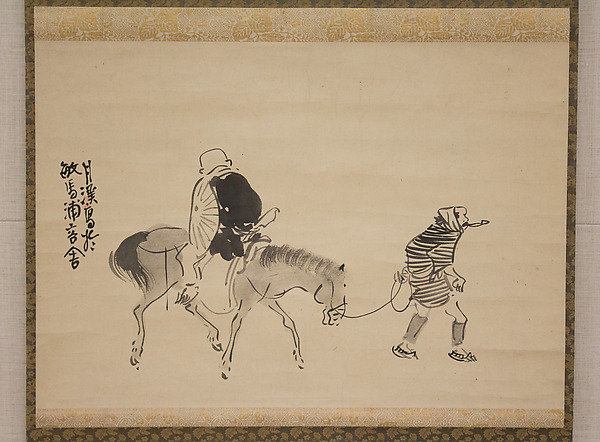
Monk Renshō Riding His Horse Backwards
蓮生法師逆乗馬図
- Date:
- after 1782, ca. 1784
- Medium:
- Hanging scroll; ink on paper
- Source:
- Metropolitan Museum of Art
Description
Monk Renshō Riding His Horse Backwards is a hanging scroll in ink on paper by Matsumura Goshun (Metropolitan Museum of Art, 36.100.18), dated to approximately 1784 — that is, the years immediately after the death of his teacher Yosa Buson, when Goshun had returned to Kyoto from his withdrawal at Ikeda and was beginning the work that would lead toward his association with Maruyama Ōkyo. The subject is the medieval Buddhist warrior-monk Kumagai Naozane, who took religious vows under the name Renshō after the Battle of Ichi-no-Tani (1184) where he had killed the young Taira warrior Atsumori. According to legend, Renshō rode his horse backwards in symbolic refusal to face east (toward Kyoto, the imperial capital and the seat of worldly authority), keeping his gaze always westward in the direction of Amida's Pure Land. The story is one of the great set-pieces of medieval Japanese narrative and was a recurring subject in nanga painting; Goshun's treatment uses the loose, calligraphic brushwork of literati ink painting to suggest both the figure's monastic asceticism and the absurd, humanizing humor of the conceit, with the horse and its mounted rider rendered against an empty paper ground that gives the picture an air of philosophical concentration. The scroll entered the Met in 1936 as part of the Howard Mansfield gift.
More Prints by Matsumura Goshun
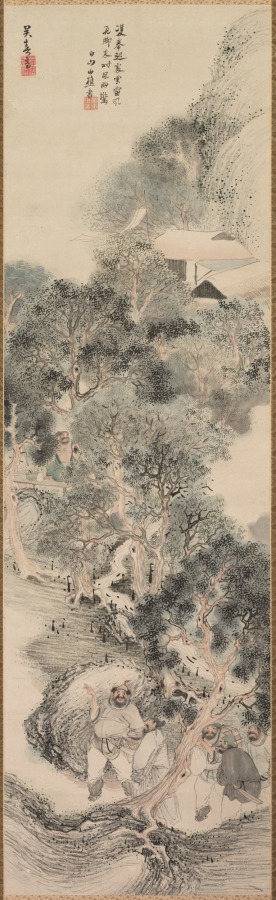
Happy Forest, from Water Margin
水滸伝快活林図
late 1700s
Hanging scroll; ink and color on paper
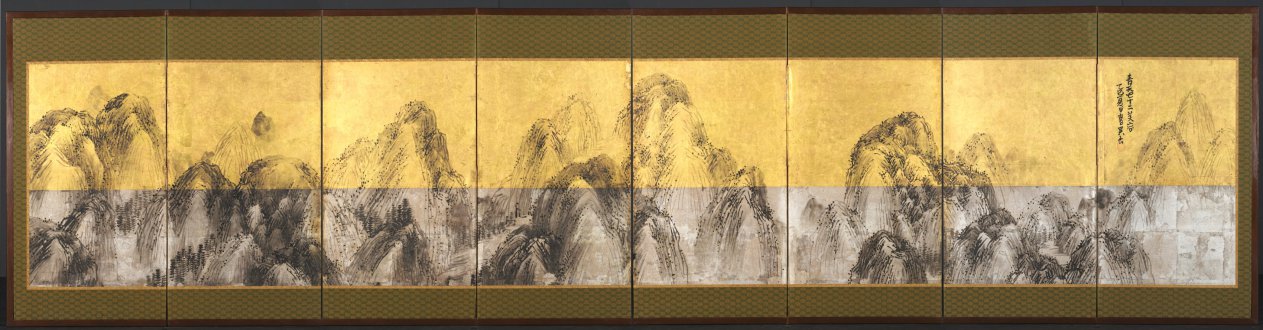
Seventy-Two Peaks Under the Blue Sky with Mount Furong
芙蓉峰青天七十二峰図
1785
Eight-panel folding screen; ink with gold and silver foil on paper
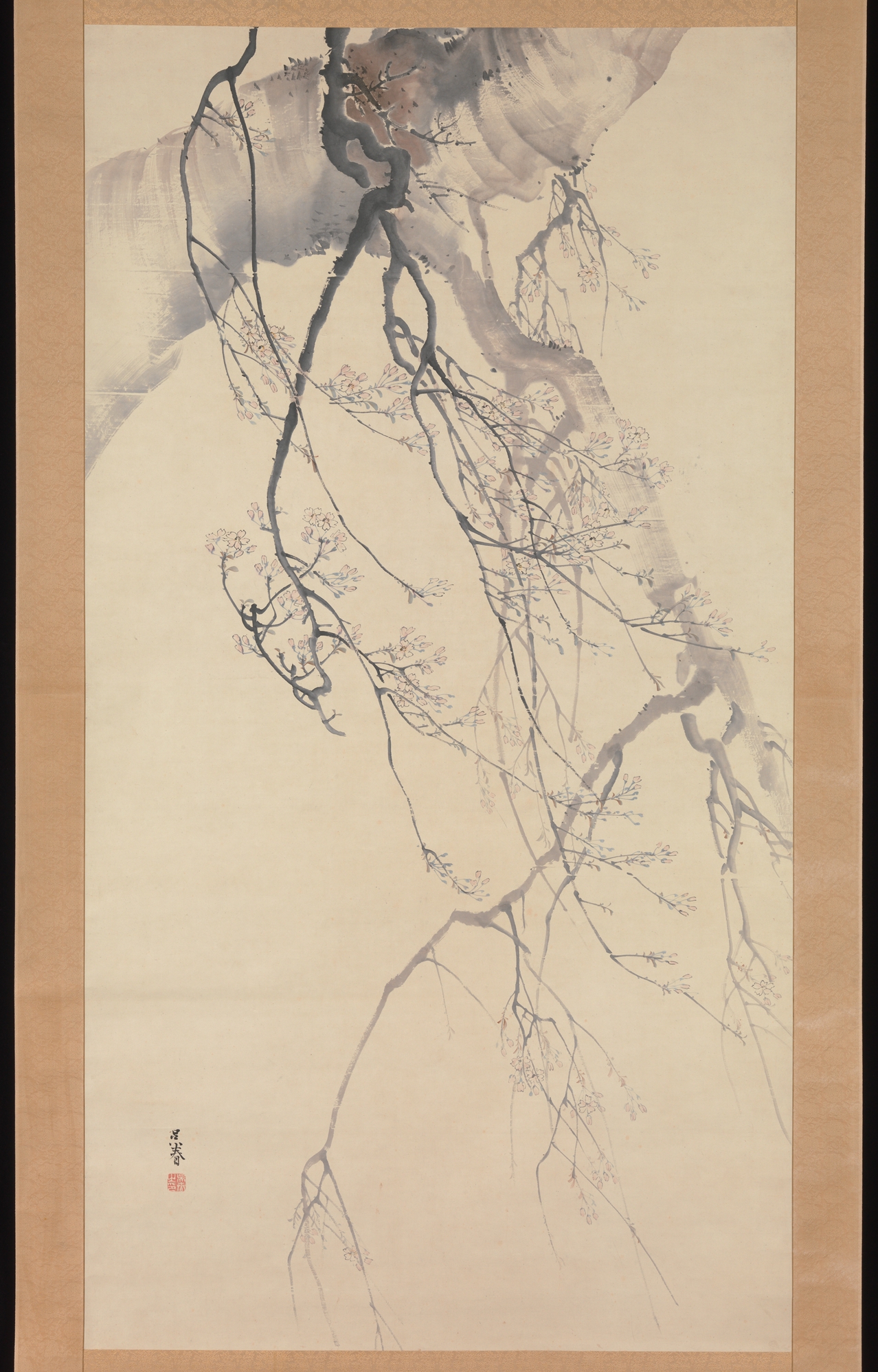
Cherry Blossoms
桜花図
late 18th century
Hanging scroll; ink and color on paper
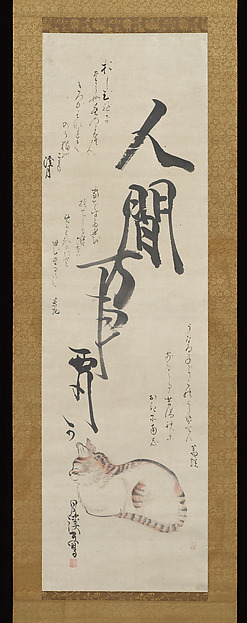
Cat with Poems: Pictorial Parody of Priest Saigyo's Legend
西行物語見立猫図
18th century
Hanging scroll; ink and color on paper
Frequently Asked Questions
Monk Renshō Riding His Horse Backwards (蓮生法師逆乗馬図) was created by Matsumura Goshun (松村呉春) in after 1782, ca. 1784.