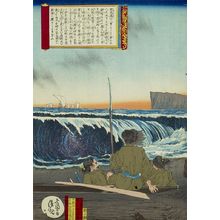
"Minamoto Tameyoshi's son Tametomo (1139-1170), from the series Episodes from Unknown Japanese History (Nihon gaishi no uchi), Meiji period, dated 1884"
- Medium:
- Woodblock print
- Source:
- Harvard Art Museum
- Image courtesy of
- Harvard Art Museum
Description
This impression from the series Nihon gaishi no uchi again features Minamoto no Tametomo, the formidable Heian archer whose legend was sustained through Kyokutei Bakin's illustrated novel Chinsetsu Yumihari-zuki (1807–1811) and other popular literary forms. Tametomo became one of the most frequently depicted warrior heroes in Japanese woodblock printing from the Edo through Meiji periods, his superhuman archery prowess and tragic defeat lending him the aura of romanticized martial virtue that Meiji historical consciousness prized. Kiyochika's 1884 treatment likely distinguishes itself from earlier [musha-e](/glossary/musha-e) through increased attention to spatial depth and tonal shading influenced by Western painterly observation. The color palette of Meiji warrior prints typically combined mineral pigments with aniline dyes introduced in the 1860s, the latter producing the saturated reds and purples visible in armor lacings and hakama. Multiple impressions within a series were standard practice, with variation appearing in ink density and the precision of registration between color blocks.