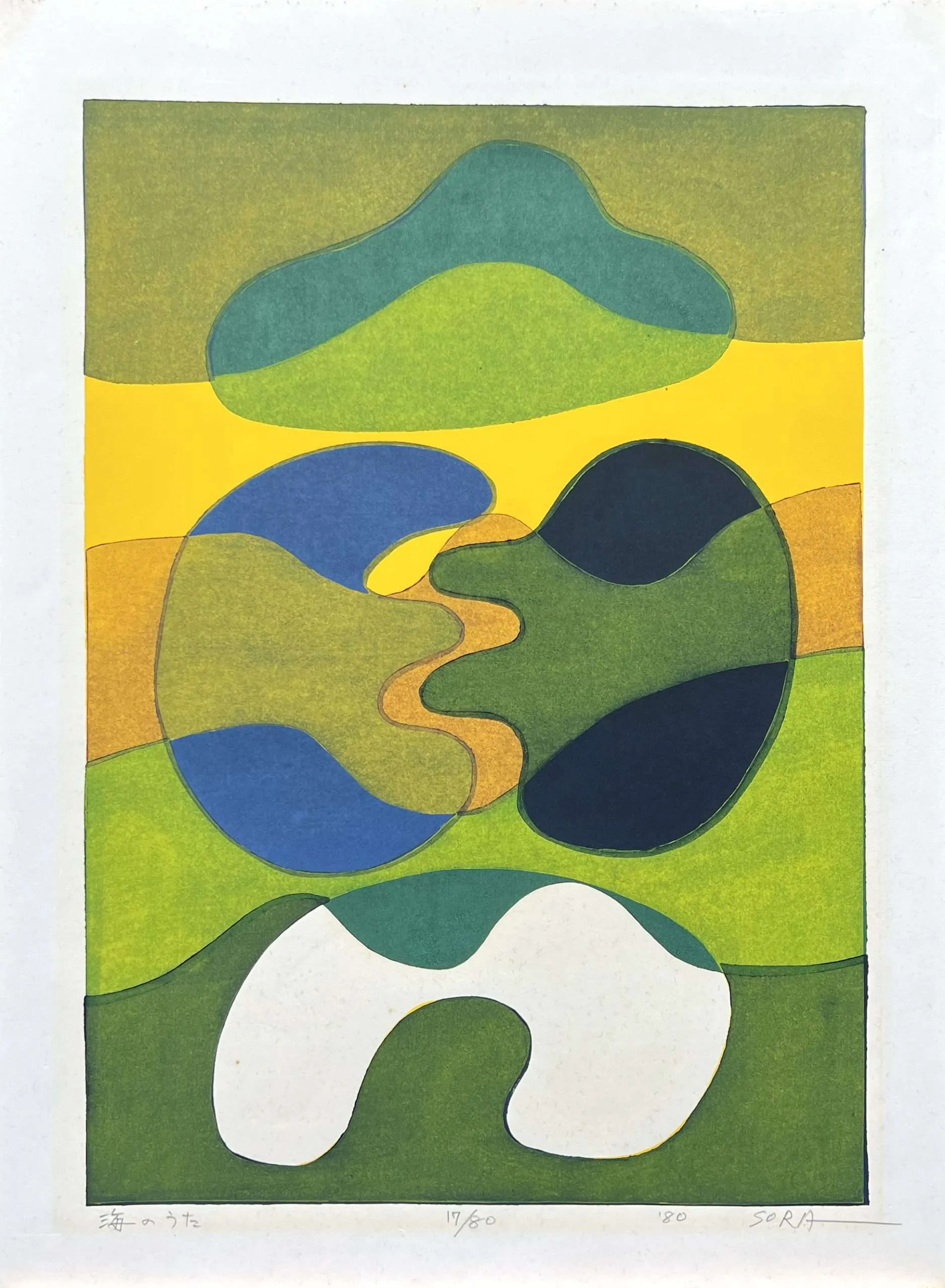
Song of the Sea
- Medium:
- Color woodcut
- Image courtesy of
- Printed Editions
Description
This color woodcut bridges the seascape tradition and abstract form, translating maritime experience into non-representational visual language. Rather than depicting waves or coastline directly, Sora likely builds the composition from rhythmic repetitions, flowing color gradations, and layered passages that evoke the sound, movement, and light of the sea without illustrating them. The dual classification — seascape and abstract — positions the work in the tradition of nature-derived abstraction common to postwar Japanese printmaking. Bokashi gradations are particularly suited to suggesting atmospheric transitions and the continuous movement of water, shifting smoothly between blue, grey, or green tones within a single block. Printed on washi using water-based pigments, the surface retains a luminous depth appropriate to a work about light on water. The word 'song' introduces a temporal and auditory dimension, suggesting the composition is organized rhythmically rather than spatially.
More Prints by Mitsuaki Sora

More Seascapes Prints
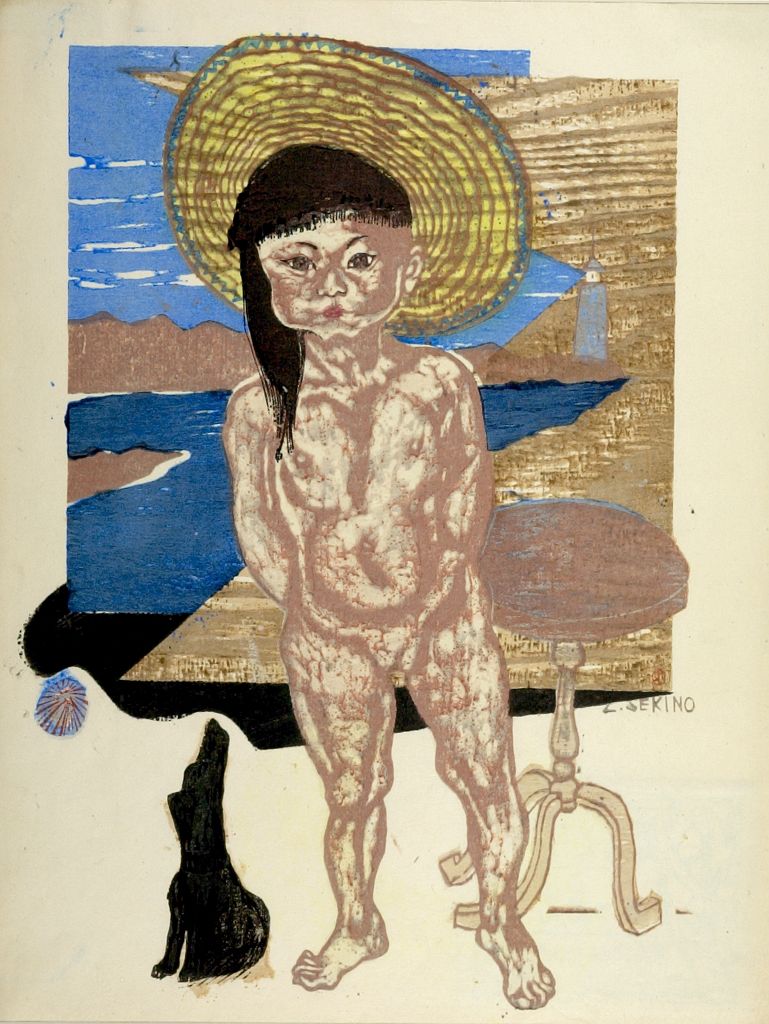
Child of the Sea
1940
Woodblock print

The Beach at Kaiganji in Sanuki Province (Sanuki Kaiganji no hama), from the series "Collection of Views of Japan II, Kansai Edition (Nihon fukei shu II Kansai hen)"
1934
Color woodblock print; oban

Pacific Ocean, Awa Province (Boshu Taikai), from the series "Souvenirs of Travel, Third Series (Tabi miyage dai sanshu)"
Boshu Taikai
1925
Color woodblock print; oban

Pine Beach at Miho (Miho no Matsubara), from the series "Selection of Views of the Tokaido (Tokaido fukei senshu)"
September 1931
Color woodblock print; oban
Frequently Asked Questions
Song of the Sea was created by Mitsuaki Sora (空充秋).
Song of the Sea depicts seascapes and abstract.