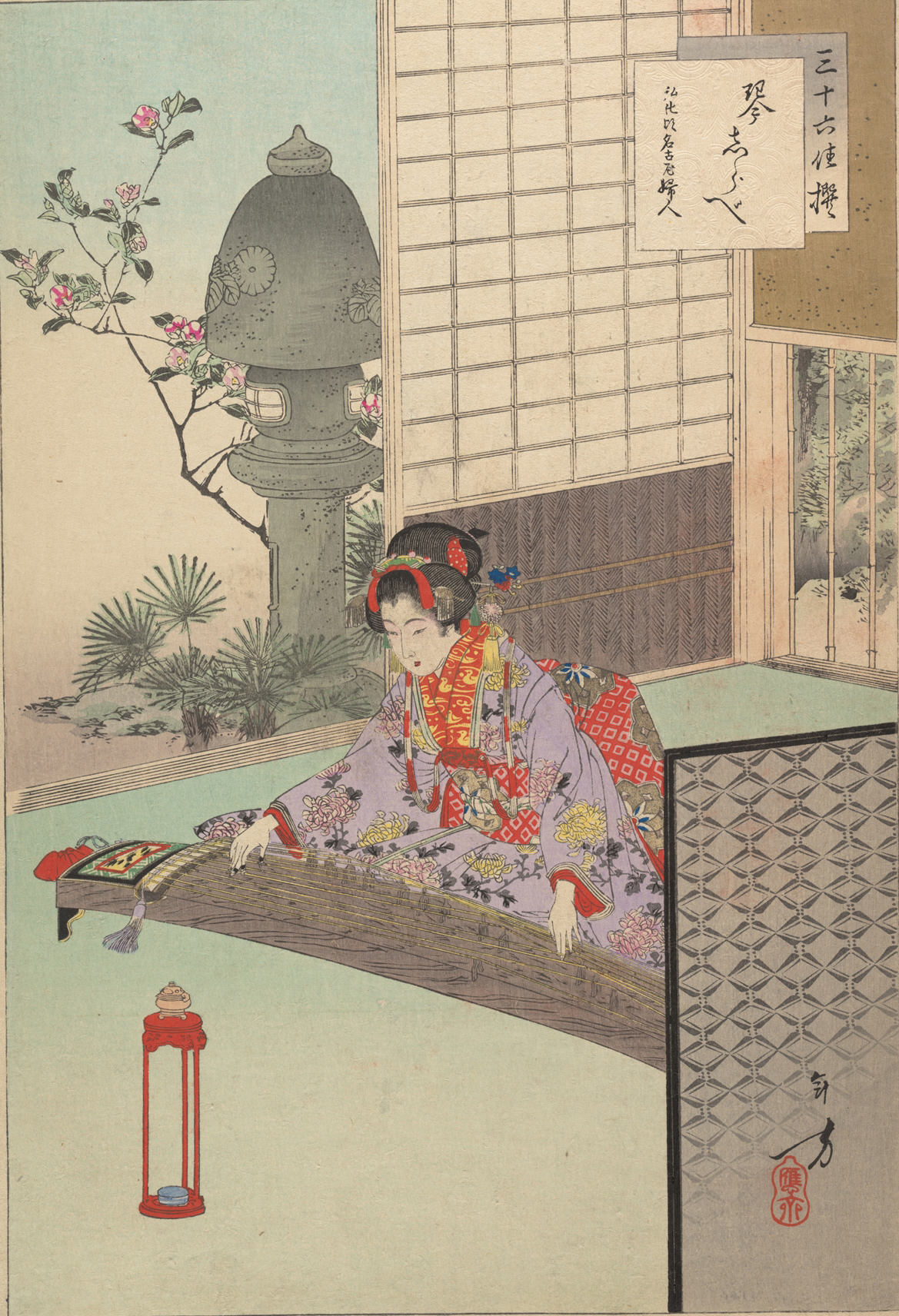
Noblewomen of the Tokugawa Period; Thirty-six Beauties (Sanjuroko kasensoro
- Date:
- 1891–93
- Medium:
- Album of 72 woodblock prints; ink and color on paper
- Source:
- Metropolitan Museum of Art
Description
Noblewomen of the Tokugawa Period from the Thirty-six Beauties (Sanjuroko kasen) is a 1891 print by Mizuno Toshikata held by the Metropolitan Museum of Art (accession reference at metmuseum.org/art/collection/search/57107). The 1891 date is significant: it places the print at the beginning of the Sanjuroko kasen series, the major bijinga cycle that would become Toshikata's most coherent and ambitious project of the 1890s. As a Yoshitoshi student, he had absorbed his teacher's commitment to historical specificity in female portraiture — to women anchored in identifiable eras and social classes rather than treated as interchangeable beauties — and the series translates that commitment into a thirty-six-print survey from the Heian court to the late Tokugawa. The Tokugawa-period entries, of which this impression is one, draw on the well-documented costume and hairstyles of the seventeenth and eighteenth centuries, allowing Toshikata to use textile pattern and stylized accessory as historical evidence. By comparison with the senso-e prints that would dominate his output four years later during the Sino-Japanese War, the bijinga of the early 1890s show a quieter and more lyrical register of Meiji prints. The Metropolitan Museum's date of 1891 corroborates the early position of this design within the run. For collectors approaching Mizuno Toshikata, Thirty-six Beauties is the definitive series in which to assess his bijinga practice and one of the strongest cycles of late ukiyo-e portraiture of women.
More Prints by Mizuno Toshikata


Frequently Asked Questions
Noblewomen of the Tokugawa Period; Thirty-six Beauties (Sanjuroko kasensoro was created by Mizuno Toshikata (水野年方) in 1891–93.