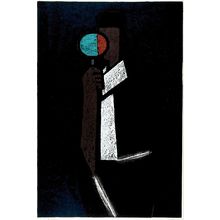
Fortune Teller, Shôwa period, dated 1957
- Medium:
- Woodblock print
- Source:
- Harvard Art Museum
- Image courtesy of
- Harvard Art Museum
Description
Dated 1957, this print depicts a fortune teller — a street-level figure drawn from everyday urban or semi-rural Japanese life — and represents Nakao Yoshitaka's figurative work from the early years of his Tokyo period. Fortune tellers, known for reading physiognomy, divination sticks, or written oracles, were still common sights in postwar Japanese cities and carry connotations of liminality and mystery. Nakao would likely have rendered the figure with the compressed, textural quality characteristic of his hand-worked printing surfaces, emphasizing mood and presence over documentary detail. The Shôwa period designation places the print within postwar Japan's cultural reconstruction, when sosaku-hanga printmakers were drawing on vernacular and working-class subject matter as well as abstraction. This print appears to be a related but distinct composition from his later treatment of the same theme.
More Prints by Nakao Yoshitaka
![[Grey Figure Posing] by Nakao Yoshitaka](https://1.api.artsmia.org/800/135848.jpg)

More Urban Scenes Prints
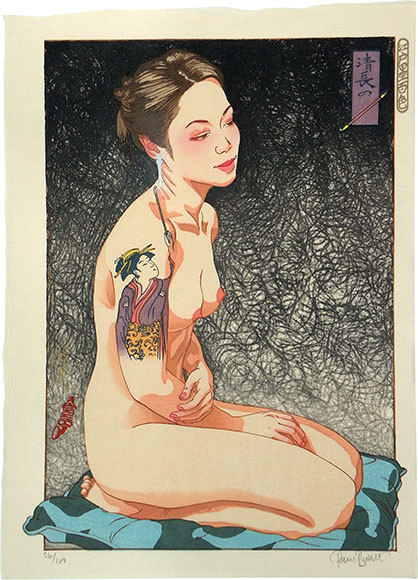
A Hundred Shades of Ink of Edo: Kiyonaga's Pipe (Edo zumi hyaku shoku: Kiyonaga no kiseru)
Woodblock print

View of Kabuki Theater from Matsuya (Ginza Matsuya yori Kabukiza), no. 3 from the series "Pictures of Ginza, First Series (Gashu Ginza dai isshu)"
1928
Color lithograph

Distant View of Mitsukoshi Movie Theater in Shinjuku from the Sixth Floor of Hoteiya (Hoteiya rokkai kara Shinjuku Mitsukoshi Musashi no kan enbo zu), no. 1 from the series "Scenery of Shinjuku (Gashu Shinjuku fukei)"
1930
Color lithograph
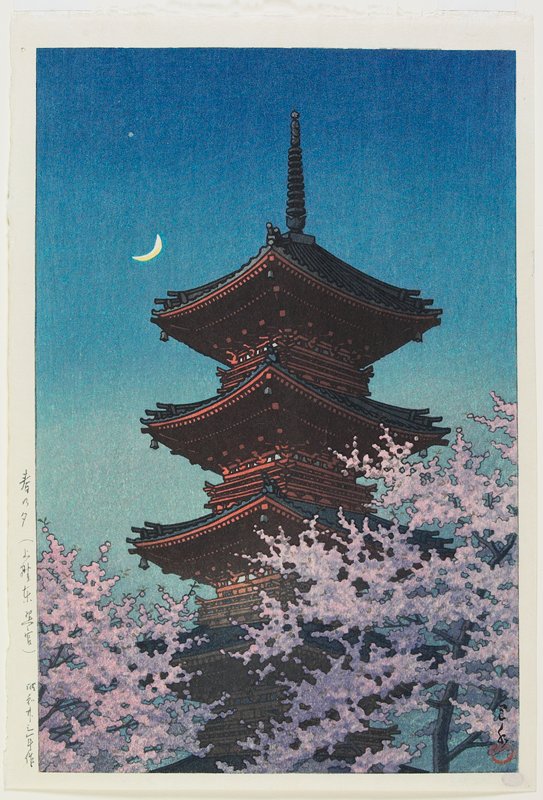
Spring Dusk at the Tōshō Shrine in Ueno
1948
Woodblock print, ink and color on paper
Featured in Collections
Curated cross-cuts that include this print.
Frequently Asked Questions
Fortune Teller, Shôwa period, dated 1957 was created by Nakao Yoshitaka (中尾義隆).
Fortune Teller, Shôwa period, dated 1957 depicts urban scenes, figures, and daily life.