
Bando Juzaburo as Seigorô
- Medium:
- Mokuhanga (Japanese woodblock)
- Image courtesy of
- Saru Gallery
Description
This portrait belongs within Shunsen's broader yakusha-e practice, which by the late 1920s and 1930s had become the most sustained body of actor printmaking in the shin-hanga movement. The character of Seigorō appears in several Edo-period kabuki plays, frequently as a townsman or rough-hewn male role calling for the bold mie poses and exaggerated kumadori facial makeup of aragoto-influenced acting. Bandō Jūzaburō was a stage name carried by actors of the Bandō line associated principally with the Tokyo stage; Shunsen's catalogue documents the leading kabuki performers of his lifetime with a portraitist's interest in physiognomic and temperamental specificity rather than in the idealised actor types of earlier ukiyo-e. The print uses the half-length okubi-e format characteristic of Shunsen's actor work, the head and shoulders close-cropped against a quiet ground that concentrates attention on facial expression. The carving registers the fine eyebrow, eyelash and hairline detail demanded by such close framing, supported by bokashi gradation in the costume and the disciplined nishiki-e overprinting that defined the technical standard of Watanabe Shōzaburō's shin-hanga editions.
More Prints by Natori Shunsen
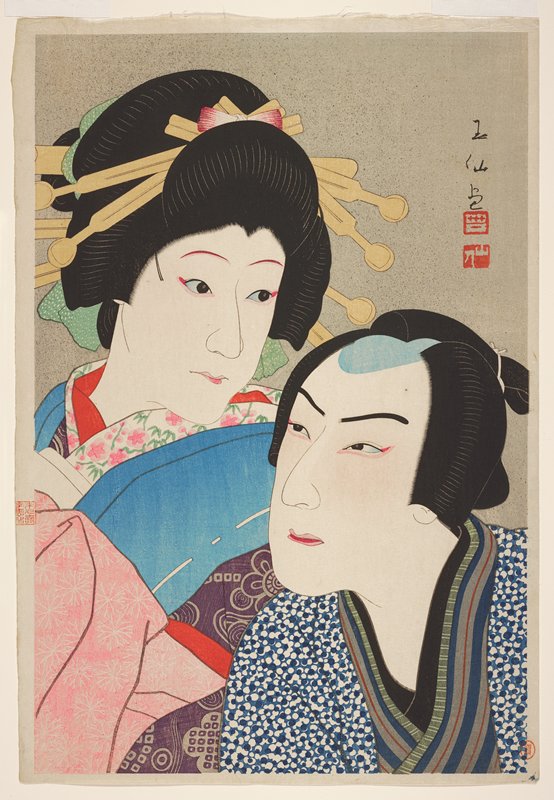
Actors Ichikawa Shōchō II as Umegawa and Kataoka Gadō XII as Chūbei
1927
Woodblock print, ink and color on paper

The Actor Sawada Shojiro as the Swordsman Hayashi Buhei, from the series “Collection of Portraits by Shunsen (Shunsen nigao shu)"

The Actor Ichimura Uzaemon XV as Naozamurai, from the series “Collection of Portraits by Shunsen (Shunsen nigao shu)"

The Actor Onoe Baiko VI as Sayuri, from the series “Collection of Portraits by Shunsen (Shunsen nigao shu)"
Featured in Collections
Curated cross-cuts that include this print.
Frequently Asked Questions
Bando Juzaburo as Seigorô was created by Natori Shunsen (名取春仙).