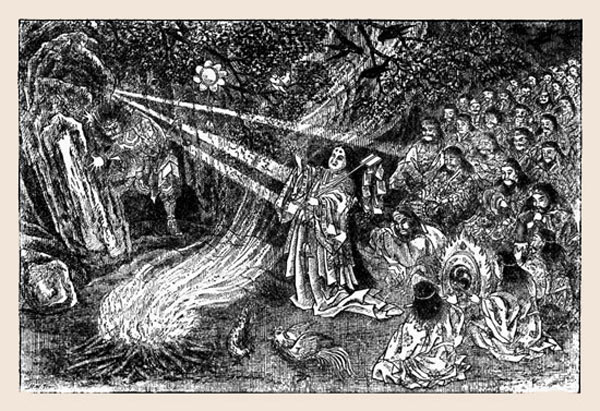
How the Sun-Goddess Was Enticed Out of Her Cave
- Date:
- 1880 (frontispiece, Trübner edition 1887)
- Medium:
- Wood-engraved book illustration after an original brush-and-ink drawing by Ozawa Nankoku of Tokyo; engraving by Henry W. Troy, New York
Description
The frontispiece of Griffis's 'Japanese Fairy World' (1880; Trübner edition 1887) is also the most ambitious of Ozawa Nankoku's compositions for the volume. The subject is the Iwato-biraki, the opening of the Heavenly Cave, in which the goddess Ame-no-Uzume dances on an overturned tub while the eight hundred myriad kami gather outside the cave-door to lure the offended sun-goddess Amaterasu back into the world. Ozawa organises the scene around the dancer's exaggerated pose at lower left and the mass of celestial figures crowded around the entrance, with the cave's tilted slab opening just enough to admit a sliver of light. The drawing is built almost entirely from brush outline, with hatching and dotting reserved for the dancer's hair, the textures of straw rope and the dark rocks around the cave-mouth. The American engraver Henry W. Troy, working in New York from Ozawa's Tokyo drawing, has cut the lines with the closely spaced parallel strokes characteristic of late-nineteenth-century English book engraving, giving the print a denser tonal range than a Japanese keyblock would carry. The plate is signed in the lower margin with the engraver's initials but carries no artist's seal; the attribution to Ozawa rests on Griffis's explicit preface acknowledgement.
More Prints by Ozawa Nankoku
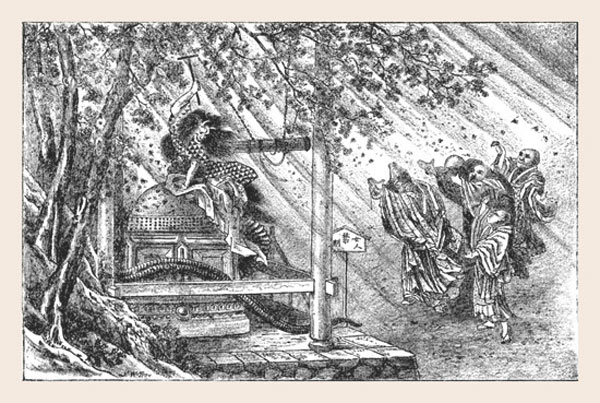
The Sorceress Melting the Bell
1880 (page 262, Trübner edition 1887)
Wood-engraved book illustration after an original brush-and-ink drawing by Ozawa Nankoku of Tokyo; engraving by Henry W. Troy, New York
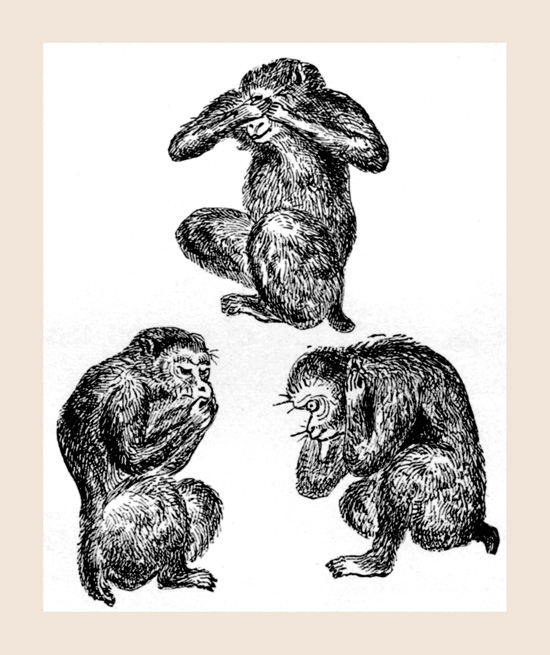
The Monkeys in Grief
1880 (page 150, Trübner edition 1887)
Wood-engraved book illustration after an original brush-and-ink drawing by Ozawa Nankoku of Tokyo; engraving by Henry W. Troy, New York
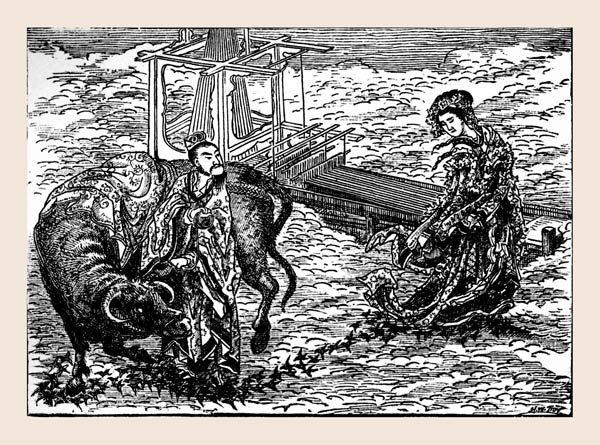
The Star-Lovers Meeting on the Bridge of Birds
1880 (page 6, Trübner edition 1887)
Wood-engraved book illustration after an original brush-and-ink drawing by Ozawa Nankoku of Tokyo; engraving by Henry W. Troy, New York
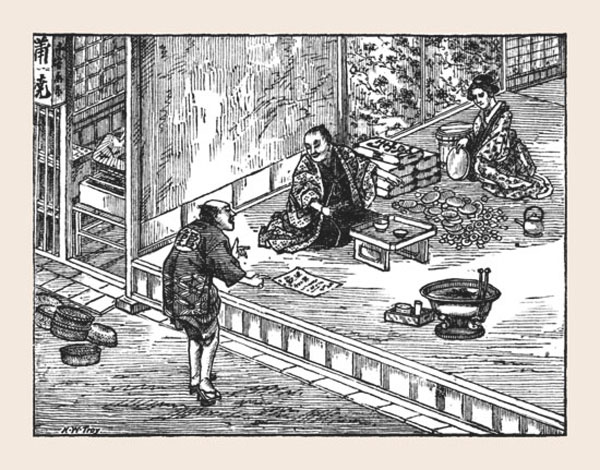
A Jingle for a Sniff
1880 (page 206, Trübner edition 1887)
Wood-engraved book illustration after an original brush-and-ink drawing by Ozawa Nankoku of Tokyo; engraving by Henry W. Troy, New York
Frequently Asked Questions
How the Sun-Goddess Was Enticed Out of Her Cave was created by Ozawa Nankoku (小沢南谷) in 1880 (frontispiece, Trübner edition 1887).