
Garden in Moonlight
by Ray Morimura
- Medium:
- Mokuhanga (Japanese woodblock)
- Image courtesy of
- Hanga Ten
Description
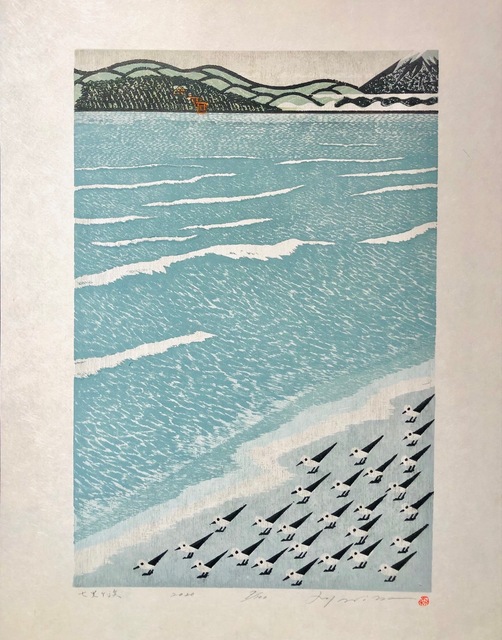
A Japanese stroll garden rendered under nocturnal illumination, with the moon either visible or implied through the silvered light cast across stone lanterns, pruned pines, and a likely pond or raked gravel sea. Morimura's nocturnes depend heavily on bokashi gradation to suggest the soft fall of moonlight, and his geometric reduction of garden elements — the conical curves of karikomi shrubs, the angular planes of stepping stones — translates clearly to the simplified tonal range available in night scenes. The palette typically shrinks to deep blues, blacks, silvered grays, and a single accent of warm light, perhaps from a stone lantern or distant lit window. The print connects to a long Japanese tradition of tsukimi (moon-viewing) imagery while filtering it through Morimura's contemporary sensibility, which emphasizes the underlying geometric structure of designed landscapes. Such moonlight scenes form a recurring motif across his oeuvre, alongside snow, blossom, and autumn-foliage variants of comparable garden subjects.
More Prints by Ray Morimura


More Moonlight Prints
![Mount Fuji on a Moonlit Night, Kawai Bridge (Tsukiyo no Fuji [Kawaibashi]), from the series "Selection of Views of the Tokaido (Tokaido fukei senshu)" by Kawase Hasui](https://www.artic.edu/iiif/2/d0960668-1e73-339a-b182-fb995a54bff0/full/843,/0/default.jpg)
Mount Fuji on a Moonlit Night, Kawai Bridge (Tsukiyo no Fuji [Kawaibashi]), from the series "Selection of Views of the Tokaido (Tokaido fukei senshu)"
1947
Color woodblock print; oban

Evening Moon at Nakanoshima, Sapporo (Sapporo Nakanoshima no yuzuki), from the series "Collection of Views of Japan, Eastern Japan Edition (Nihon fukei shu higashi Nihon hen)"
March 1933
Color woodblock print; oban

Matsushima in Moonlight (Tsuki no Matsushima)
1919
Color woodblock print

Kiyozumi Garden in Moonlight
January 1938
Woodblock print, ink and color on paper
Frequently Asked Questions
Garden in Moonlight was created by Ray Morimura (森村玲).
Garden in Moonlight depicts moonlight and gardens.